Retractable vs. Traditional Cantilever Material Unloading Platforms: Which One Is Better?
A traditional fixed cantilever material unloading platform is usually the better choice when the loading point stays in one place. It has fewer moving parts, simpler inspection, and a lower upfront cost. A retractable platform wins when clearance is tight, several trades share one floor edge, or the deck must leave the façade between deliveries. Neither design is better in every case. Load rating, anchoring, site clearance, crane access, and maintenance capacity decide the answer. I will walk through each factor below so you can match the platform to your project.
What a Cantilever Material Unloading Platform Is and How the Two Designs Differ
What Is a Cantilever Material Unloading Platform?
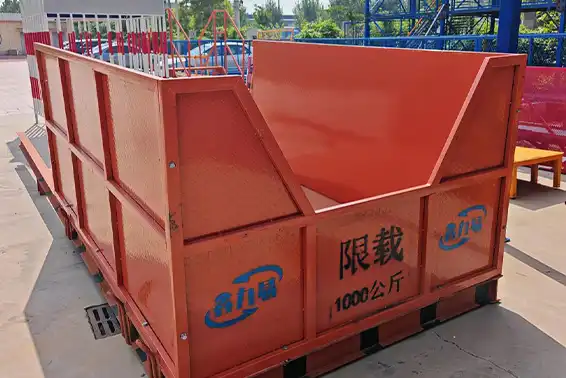
You can grab your stuff off this steel platform sticking up off the floor. They are loaded onto a tower crane and carried in. Most of the time they are carrying bundles of rebar, formwork and curtain wall panels. A rear frame, beams and posts keep the construction block together. The deck, guardrails, toe boards, gate and non-slip surface are the most crucial features. They add locks , springs , rollers , or cylinders to different sorts that can be pushed back . As for the steel itself, it is not that crucial. We need to know how much weight the slab can take and how the foundation is constructed.
How Retractable Platforms Work
Retractable cantilever material unloading platform can be slid, folded, lowered or pulled away when not being used for unloading. This is useful when there is construction going on on the exterior of the building, or when people are moving about in various ways each week. If it is a moving hinge, roller track, cylinder or manual lock, you will have to conduct additional technical maintenance to maintain it in excellent condition. If people want power, they may require someone who knows how to utilize them and how to power them. The site is still available in various ways. “Buyers need to know what happens if the power fails and who can turn it off to see if the added flexibility is right for the site.
How Traditional Fixed Platforms Work
A fixed cantilever material unloading platform remains open for the whole period of operation. The structure is easier, so it takes less time to set up, check, and train the team. “The workers know where the landing zone is and the people that operate the crane can plan their moves to stay out of it.” That's a wonderful technique to accomplish lengthy chores that have to be done again and over, like lifting metal and concrete up floors all day. Even when not in use, the deck occupies the front space. It could be challenging to work on lifting pathways, scaffolding, or cladding due of this. If the sizes are the same, it is also straightforward to utilize objects from other towers and place more than one order.
Comparing Performance, Safety, and Operational Efficiency
Load Capacity and Structural Strength
What you need to know about a cantilever material unloading platform is more than just how much weight it can hold. How it is grounded, the size of the deck, and the type of steel used all play a role in how it is put together. End users, point loads, impact loads, and safe working loads are all terms that people who want to buy something should know. Adding moving forces is what pallet jacks and hoists do. AISC 360 teaches engineers how to plan steel buildings and ASCE/SEI 37 tells them about loads that happen while they work. Plain Xinjiuyi platforms can hold up to 3,000 kg, while heavy-duty ones can hold up to 5,000 kg.
Safety Features That Matter on Site
All platforms require guard rails, toe boards, an access gate, non-slip decking, visible load markings and safe locations to carry objects. OSHA’s 29 CFR 1926.502 fall safety regulation states that the top rail must be 42 inches high, plus or minus 3 inches. The top rail must be capable of supporting 200 pounds, and toeboards must be at least 3.5 inches high. OSHA allows the rail to be taller if the system meets all other criteria. If a task requires a different height, we alter the fences. The norm is 1,200 mm high. Retractable kinds may now have movement interlocks, hydraulic protection, position confirmation, and written actions that halt harmful operation.
Operational Efficiency: Advantages and Limits
When not in use, flexible platforms should not have cranes and automobiles. They also need less space and may be employed with varied designs or at more than one site for unloading. They cost more since the sensors, locks, hinges, wheels, cylinders and operators have to be trained and audited.” A set foundation is straightforward to use and does not cost much. You can put them up, inspect them, and keep them up quicker since they have fewer moving components. They are useful for extensive tasks when you need a solid area to move and load a lot of material. The primary problem is that they take up a lot of room. Look at your daily lifts and trades that share the front and discover which method performs better.
How to Choose and What the Choice Costs?
Start With Site Conditions
Start with the house and the crane. Write down the height of the installation, the details of the slab edge, how to get in and out, the clearance, the weather exposure, and the tower crane's path to the platform. Next, make a list of the safe working load, the deck size, the guardrail configuration, how often they will be used, and any power needs. Many times, a stationary cantilever material unloading platform is the best choice for a stable place to load. There might not be much room for one that can be moved, or the steps of the job might change. High-rise floor edges are places that tower cranes cannot see or reach; we have steps that can help you get to these floors. Tell the supplier about these things right away so that the quote works.
Compare Total Cost of Ownership
Movable platforms are usually more expensive than fixed platforms because they feature additional components or systems such as hydraulics, electricity, interlocks or mechanical elements. Standard size fixed frames are cheaper to begin with. Price isn't the only thing that matters. There are other factors. Anchor, pulling gear, training, supervision during installation, shipment, insurance and getting the machine up and operating. Then you have to consider about the repairs, maintenance, downtime, energy consumption and rust treatment the equipment will require over its lifetime.” Money that has already been utilized is throughout more than one tower. Ask each vendor to write down the prices of the equipment, safety equipment, shipment and installation so that you can compare quotations line by line.
Common Buying Mistakes
The greatest error people make is looking up the load rating of anything before they purchase it. Other factors that matter include impact, projection, point loads, anchoring, slab quality, weather. The second error is to believe that the usual anchoring would fit any construction. The site developer should work on the structure with the seller. Third, there is no written instruction for the folding units, explaining how to use them, lock them, save them, what to do if the power goes out, etc. People should also verify the Incoterms, wait time, package sizes, shipping paperwork, warranty conditions and whether spare components are available when buying from another nation. Planning ahead of ordering avoids the delay on the slab or at the port.
Which Platform Is Better for Your Project?
When a Retractable Design Makes Sense
Pick a cantilever material unloading platform that you can move when there is not enough space, the deck needs to be moved away from the wall to make room for supplies, or more than one job needs to use the same space. A case that comes up a lot is an infill area in a city with narrow borders. Managing space or being flexible is only worth the extra cost if it changes safety or output in a way that can be tracked. If your team has few maintenance staff, you should think about how the extra parts will change their workload. Before you decide, find out what to do in case of an emergency and if there are extra parts. The most important things are always how safe the grounding is and how well the frame fits.
When a Fixed Design Is the Better Fit
A fixed platform that can be used every day is the best kind when there is enough room and a clear cost goal. If all the platforms are the same size, builders in charge of more than one tall building only have to train their workers once. Plates are moved up as the floors go up. To do daily checks, you do not need to move as many things around. Plus, you can see if a weld cracks or bends better. Sometimes, things like curtain wall, rebar, and formwork need to be brought in at a certain floor edge. There is less work to do on a stable platform that was built well.
How Xinjiuyi Platforms Fit High-Rise Work
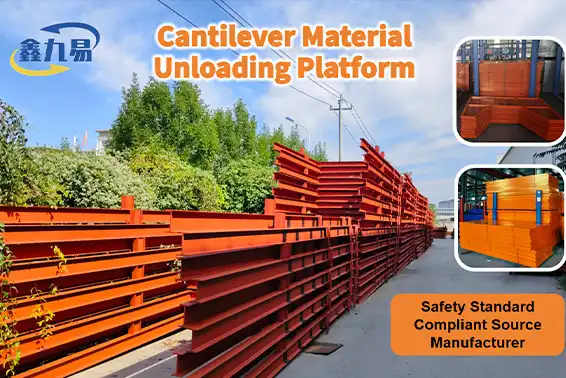
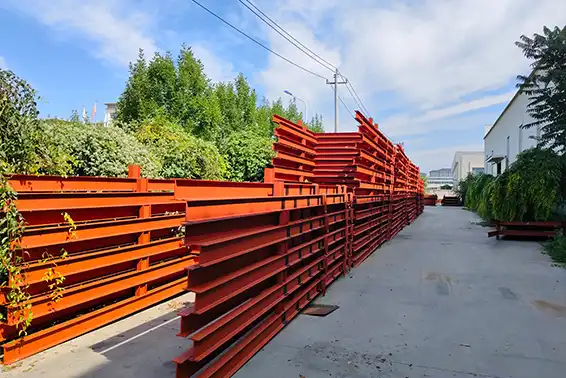
Our Xinjiuyi cantilever material unloading platform is made up of several pieces of modular steel. A tower crane puts them in place. They are usually between 3,000 and 4,000 mm long, 2,000 mm wide, and 6,000 to 7,000 mm tall, weighing 450 to 480 kg. I-beams or channel steel in Q235B or Q345B are used to make the main beams, and 5# channel steel is used for the auxiliary beams. Decks are made of steel plates, and grating is an option. The nodes, guardrails, and toe boards are all glued together completely. It is easy to see because the machine is painted yellow and black. The edge of this simple form stays the same. Let us know about your site, and our engineers will look at options for a retractable idea.
How a Qualified Supplier Supports Custom Platform Projects
Documents to Request Before Ordering
People on the job site in charge of safety will want proof, not promises. This is what I think you should ask for:
• Structural calculation sheet: Figure out how much weight the structure can hold and how you plan to support the platform. Get a quote that takes all of these things into account. After that, your engineer can check both the slab and the platform at the same time, without having to guess which assumptions the supplier made.
• Material and weld records: Ask the steel mill for proof of the grade and thickness, as well as records of the measures and checks of the joints. For each beam and link point, you can then match what you see on the ground with the picture.
• Test and operation records: If your project needs one, ask for a manual on how to do things, a report on a load test, and a record of how thick the coating is. The checks are taught to the crew, and before the first lift, the safety team has written proof.
Quality Control and Surface Protection
Checking the steel is the first step to making sure it is good. A mill certificate on each piece of steel tells you what grade it is and how thick it is; we do not skimp on types to save money. Load-bearing welds are checked for cracks, gaps, and only some fusion. We also see how big they are and what they look like. Most people cover and iron things to keep them from rusting. It can also be powder coated. As per the ASTM A123/A123M standard, zinc hot-dip galvanizing should be used to cover iron and steel. The ISO 9001, ISO 14001, and ISO 45001 marks are on file with our business. Before you move platforms from one tower to another, you should know how thick the sheet is.
Anchoring, Customization, and Delivery Support
A platform stays in place by being anchored in one of two ways. Strong rods are run through the slab with the through-wall tie rod method. The weight is spread out among plates on the back. The top and bottom slabs stay in place when holes cannot be drilled in them thanks to the telescopic jack bracing system. Your engineer needs to find the one that fits the slab and measure how far apart the edges are. You can also change the finish, length, width, and height of the surface. Our pre-sales team can also help you plan by drawing things. When lifting the crane, it is easy to get the wire rope through a curved lifting ring. Our group helps plan, take care of, and give advice at the spot.
Conclusion
An unloading platform hangs from the edge of the floor and connects to a crane. The plan will see which one works best for the job site. A cantilever material unloading platform that can be moved makes more room and causes less trouble when plans change, but they have moving parts that need to be checked and trained on. A fixed platform is cheaper, easier to check, and works best when there is enough room for a steady loading point. It is not enough to know how heavy the load is for safety; remember to pay attention to anchoring, projection, the state of the slab, and guardrails. It costs money to buy something and time to set it up and keep it in good shape. Charts and records help engineers be sure of the choice they make. Pick a platform that fits your place's height, number of lifts, and maintenance needs.
FAQ
Is a retractable base better than a fixed one?
Not all the time. It is very important to have a safety expert, attaching and locking systems, load control, training, and tests. A stable base with good welds and the right fixes might be safer than a retractable unit that is not taken care of right.
How much weight can a cantilever material unloading platform hold?
Size, weight, support, grounding, and load spread are the things that matter. Our regular models can hold between 1,500 kg and 3,000 kg, and heavy-duty Xinjiuyi models can hold up to 5,000 kg.
How can Xinjiuyi customize a platform?
Yes. We can change the finish, length, width, and height of the surface. Before we start making things, we will look over your plans, the loads that they need to hold, and the highest edges that can be reached.
What should I include in a quote request?
Tell them how big the platform is, how much weight it can hold, what the floor plans look like, how often it runs, where it is going, and when it will get there. It is possible for different sellers' quotes to be based on the same data. This makes it fair to compare deals.
Request a Customized Cantilever Material Unloading Platform Recommendation from Xinjiuyi
Xinjiuyi is a cantilever material unloading platform manufacturer in Cangzhou, Hebei, with ISO 9001, ISO 14001, and ISO 45001 certification and full customization support. Our modular, galvanized platforms suit repeated reuse. Send your drawings, rated load, dimensions, and delivery needs to global@xjy8.com, and our team will recommend a suitable configuration.
References
1. ASCE/SEI 37-14: Design Loads on Structures During Construction, 2014
2. ANSI/AISC 360-22: Specification for Structural Steel Buildings, 2022
3. OSHA 29 CFR 1926 Subpart CC: Cranes and Derricks in Construction, 2010
4. OSHA 29 CFR 1926.502: Fall Protection Systems Criteria and Practices, 1994
5. ASTM A123/A123M: Standard Specification for Zinc (Hot-Dip Galvanized) Coatings on Iron and Steel Products, 2017
6. ISO 45001: Occupational Health and Safety Management Systems, 2018