Hoist Cage: Safety Features, Design, and Applications Explained
A hoist cage is a precision-engineered vertical transport enclosure that serves as the load-carrying component of a construction hoist or industrial elevator system. Designed to move both personnel and materials safely between floor levels, it integrates directly with rack-and-pinion or wire rope drive mechanisms. On high-rise job sites, a properly specified construction elevator cage eliminates the logistical bottleneck of manual material handling, cuts worker transit time, and reduces the risks that come with unguarded vertical movement. This article breaks down exactly how these enclosures work, what separates a compliant unit from a substandard one, and how to source the right configuration for your project.
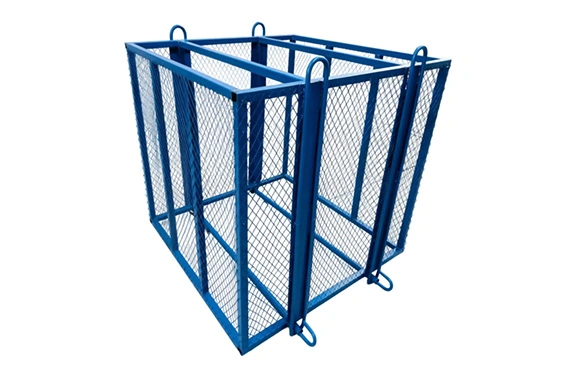
Understanding Hoist Cages – Design and Key Features
What a Hoist Cage Actually Is?
A "hoist cage" is the enclosed car that moves along a system of hoists that climb masts. It is a foreign standard like EN 12159 or ANSI A10.4 that says it can't be used for construction workers or tools. This is where the drive unit meets the cage that holds the object. It could be a group of workers, a load of drywall, or steel support bars and so on.
Structural Framework and Materials
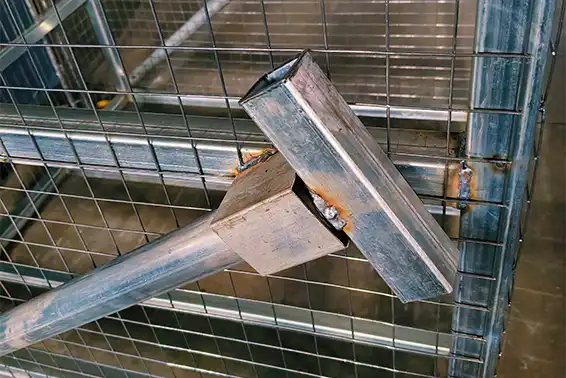
The body of the frame is made up of channel steel, thicker I-beams, and cylindrical tubes that have been galvanized. Usually, these are cut into pieces that are 30 mm x 50 mm and have walls that are 1.5 mm thick. Most businesses use Q235 or Q345B high-tensile steel. Full-penetration welds and Non-Destructive Testing (NDT) are done on key stress spots before they are shipped. The base plate has a checkered pattern that makes it less likely for workers to slip while they load and unload. It comes in three standard sizes: 1,400 mm x 1,400 mm x 1,400 mm. However, you can change all three to suit your needs.
Design Variants and Configuration Options
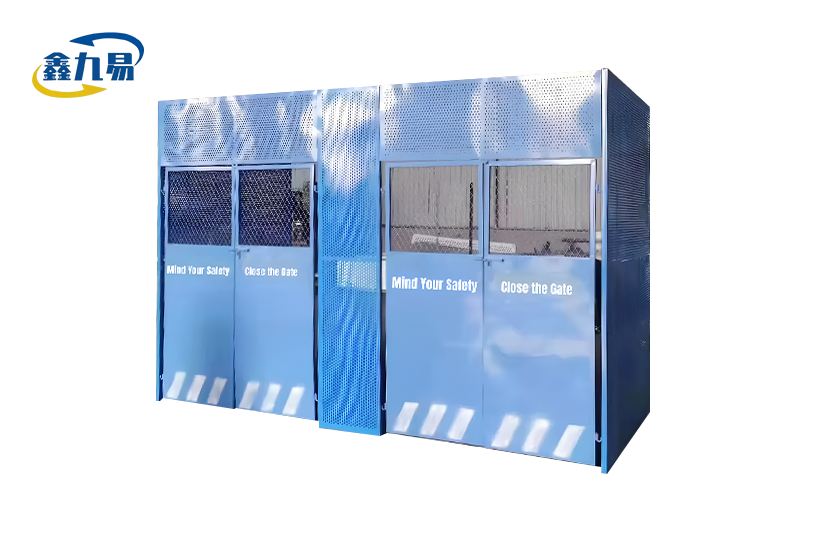
Construction lift cages come in two different styles: single-cage and twin-cage (SC200/200). To double output without making the site bigger, a twin setup puts two separate cages on the same mast. For towers taller than 100 meters, this is a common choice. When there is a chance of things falling, enclosed models with side mesh walls and canopies that stop things from falling must be used. Of course you can't choose not to have automatic door interlocks and overload alarms. They are needed on most controlled job sites in the US and around the world.
Hoist Cage Safety Standards and Compliance
Applicable Standards You Need to Know
In the US, OSHA 29 CFR 1926.552 sets rules for building hoists. It includes upper load limits, gate standards, and check-up times. Around the world, EN 12158-1 covers hoists for materials and EN 12159 covers hoists for people. GB/T 10054 is used for Chinese-made goods that will be sold in China or other countries. Before placing an order, procurement managers who buy from companies in other countries should check to see what standard the unit meets.
Built-In Safety Features That Matter at Acceptance
These days, construction hoists have a lot of safety features that you can't do without. In a compliant cage, these are the main safety features you can find:
- Automatic door interlock: The drive circuit disengages unless all cage and landing doors are fully closed and latched, preventing movement with an open gate.
- Overspeed safety device (SAJ series): Engages mechanically if descent speed exceeds the rated limit, arresting the cage before free-fall can occur.
- Overload alarm system: Triggers an audible and visual alert when the payload exceeds the rated capacity (typically 2,000 kg), preventing structural overload.
- Top anti-falling canopy: A steel overhead guard rated to resist impact from dropped objects, required on sites with overhead work activity.
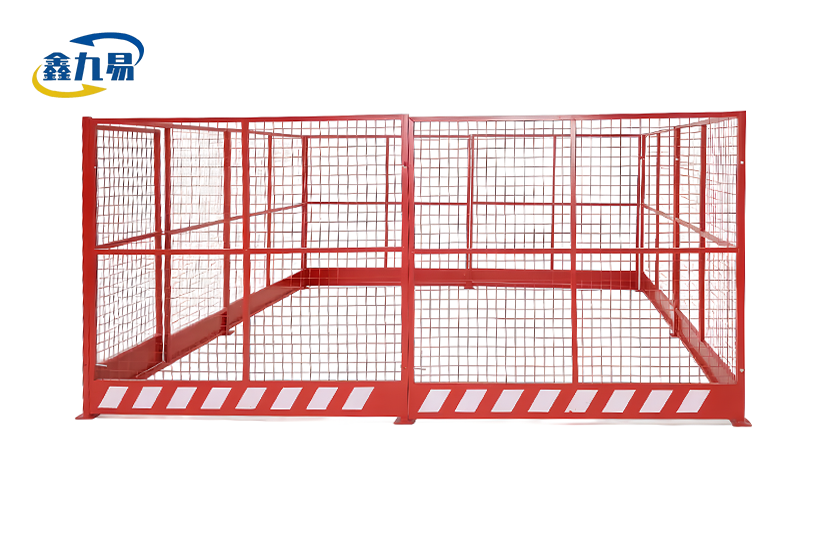
- Side mesh panels: Perforated enclosure panels with controlled aperture sizing that prevent tools or debris from passing through the cage walls.
Comparison of Hoist Cages – Making the Right Choice for Your Business
Hoist Cage vs. Elevator Cage
The rules for a construction hoist cage are different from the rules for an elevator cage in a fixed building. Asme A17.1 is the standard for elevator cages. These cages are made to be used in buildings for a long time and many times. Hoist cages are temporary tools that can work in rougher conditions and are designed to be taken apart and put back together again. Compliance problems show up during inspection when the two groups are mixed up when they are being bought.
Steel vs. Galvanized Configurations
Standard Q235 steel frames with high-temperature baking paint work well on most interior building sites. When used in seaside projects, chemical plants, or bridge pylons that are exposed to salt air and water, galvanized rectangular tube framing is much less likely to rust. This layer must be at least 85 microns thick before it can be accepted. A magnetic gage can be used to check this. The aluminum alternatives are lighter than galvanized steel, but the steel is better at resisting impacts and can be fixed on-site by welding.
Single Cage vs. Twin-Cage for SC200/200 Systems
The SC200/200 dual-cage frame is the most common type used on big high-rise projects. Each cage can hold up to 2,000 kg of weight at most. When both cages are running on the same mast at the same time, they can move up to 4,000 kg per cycle. This is very helpful for logistics during the finishing stages, when a lot of different kinds of material need to be moved at once. To make sure there are no alignment issues during installation, procurement managers should check that the cage supplier can make matched pairs with the same size tolerances.
Procurement Guide – How to Source Quality Hoist Cages
Evaluating Manufacturers and Certifications
Verified licenses tell you which suppliers you can trust and which ones you can't. If you work with European or international contractors, make sure they have ISO 9001 certification for quality management, ISO 45001 certification for health and safety at work, and ISO 14001 certification for environmental management. As usual, ask for the NDT weld inspection reports and load test records before sending. Don't think about it after the fact.
Custom Fabrication and Bulk Purchasing
Standard hoist cage sizes work for most SC-series hoists. Different types of projects, like bridge pylon work, industrial chimney upkeep, and metro station building, often need non-standard openings, better lifting points, or different side-panel layouts. If a maker has its own engineering team, they can take a look at your site plans and come up with a best-fit setup. A rental fleet or OEM partner can usually get better lead times and make sure that all of the units are the same size when they place a large order.
Shipping and Installation Considerations
It depends on the type of freight and the port where it will arrive whether the cage frames are shipped flat or already put together. There is more room in the container for pre-assembled units, but less work needs to be done on-site. Before the container leaves the plant, check that the custom units' tolerances for size match the interface between your drive units. It takes time and costs money to make changes to mast-interface frames after they have been delivered. When you place an order, you should always ask for installation directions and direct contact information for technical help.
Applications of Hoist Cages in Industry: Case Examples and Benefits
High-Rise Commercial Construction
Two construction elevator cages run at the same time on skyscrapers taller than 100 meters. They move both workers and finishing materials like glass panels, drywall sheets, and MEP parts. The welded frame is stable and won't bend even when it's fully loaded. The non-slip base plate makes sure that workers safely can get in and out with tools and equipment.
Municipal Bridge and Infrastructure Projects
In order to build a bridge tower, you need cage systems that can fit inside narrow concrete shafts that are sometimes tilted just a bit. A modular cage design with movable entry points and stronger lifting points keeps the structure strong all the way up the pole. This gets around the shape issues.
Industrial and Venue Maintenance
For repair work on power plant chimneys, arenas, and show halls, you need cage systems that can work with current cranes and handle acidic environments. These needs can be met by galvanized framing and electrical options that won't blow up. From what the U.S. Bureau of Labor Statistics says, falls are still the main reason people die on the job, and in 2022, they will be the cause of 36.4% of all building deaths. Use of building hoists that are properly sized and kept is one of the most direct ways to stop this.
Conclusion
The right kind of building hoist cage is a structural safety system, not just a simple thing you can buy. There is paperwork that shows how well the weld was done, that the door interlock worked, that the overspeed device was tested, and that the measurements at the mast interface were correct. If these things are missing, the unit is not approved. That way, procurement managers will not be surprised when these requirements aren't met after the goods have been delivered. Instead, they will see them as normal things to check before creating an order. Building elevator cage systems made by Xinjiuyi are approved by ISO 9001, ISO 45001, and ISO 14001 standards. You can get NDT results and full customization help if you ask for them.
FAQ
What safety features should I prioritize when buying a hoist cage?
Electronic door locks, a safety device for overspeeding (SAJ series), and an overload warning are the three things that can't be changed. If you don't have written acceptance papers for each one, your unit is likely to fail site inspection. On job sites where people work up high, you need both a canopy that keeps people from falling and side mesh panels with standard-sized holes.
How do I choose the right load capacity?
You should match the rated load to the most material you need in a single cycle, not the most material you need most of the time. Almost all high-rise building supplies can fit in a cage that can hold up to 2,000 kg. If you need to move big structural parts as part of a project, check the lifting point reinforcing design and get a copy of the 125% overload test certificate. This proves that the parts did not change shape permanently during the test.
Can cage dimensions be customized for non-standard installations?
Yes. However, if a maker has their own engineering team, they can change the height, width, and entry design to fit bridge pylons, industrial shafts, or other tower crane interfaces. The normal footprint is 1,400 mm x 1,400 mm x 1,400 mm. Send in your site plans during the pre-order meeting to make sure they meet the last requirements before production starts.
How often does the safety brake need testing?
Industry standards say that a drop test needs to be done every three months. The test shows that the overspeed governor works at the right trigger speed, and the cage doesn't move because of the brake. Keep a record of each test with the date on it for the tester to look over.
Partner with Xinjiuyi for Your Next Hoist Cage Project
These industrial-grade hoist cage systems are sold by Xinjiuyi. They are made to meet ISO 9001, ISO 45001, and ISO 14001 standards. There is all the paperwork you need for NDT with these systems, and they can be changed right in the factory. Just before we start making something, our engineering team looks over your specs. This is true whether you need a standard bridge pylon configuration or a SC200/200 twin-cage set that matches. You can call us at global@xjy8.com or go to xjy8.com to get a price and talk about your project right away. You can also see all of the building hoist cage goods we have for sale.
References
1. Construction Safety Regulations and Hoist Equipment Standards — OSHA Technical Manual, 2021.
2. EN 12159: Builders' Hoists for Persons and Materials — European Committee for Standardization (CEN), 2012.
3. Census of Fatal Occupational Injuries Summary — U.S. Bureau of Labor Statistics, 2023.
4. ASME A10.4: Safety Requirements for Personnel Hoists and Employee Elevators — American Society of Mechanical Engineers, 2020.
5. Non-Destructive Testing of Welds: Ultrasonic Testing — ISO 17640, International Organization for Standardization, 2017.
6. GB/T 10054: Construction Hoists — Standardization Administration of China (SAC), 2005.