ZLP500 Electric Cradle Safety Lock: Rope Angle and 30kN Test Guide
When project managers and safety officers evaluate suspended access platforms, they immediately ask about the safety lock's reliability under real-world stress. The ZLP500 Electric Cradle Safety Lock operates through a centrifugal brake mechanism that activates when rope speed exceeds safe limits or when the platform tilts beyond acceptable angles. This guide walks you through the critical relationship between rope angle positioning and the 30kN load test—a certification benchmark that confirms whether your ZLP500 Temporary Cradle meets international fall protection standards for high-altitude construction work.
Understanding the ZLP500 Safety Lock System
The most important part of any suspended access equipment is the safety lock. It is attached directly to the work platform and grabs the suspension rope right away if it senses an unusually fast descent speed or unstable platform.
How Does the Safety Lock Protect Your Crew?
A dual-trigger device is built into our LSA30 safety lock type. The speed of the rope affects the spinning mechanism, and the tilt sensor turns on when the platform angle moves more than 3° to 8° from vertical. This double safety takes care of the two most common types of failure: a broken hoist and uneven loading that causes the platform to fall over. Unlike passive stop systems, the LSA30 doesn't need electricity to work. This means that it will protect you even if the power goes out on the job site.
Rope Angle Impact on Safety Lock Performance
How quickly and accurately the safety lock connects is directly related to how the wire rope is aligned. When the suspended rope is hanging straight up, the load is evenly distributed, and the centrifugal mechanism works within the range of sensitivity it was meant to work in. However, rope angles can be off from vertical when building facades curve or rooflines make obstacles. When the angle is greater than 8°, horizontal forces are introduced that may make the lock not engage right away or wear the brake pads unevenly. The ZLP500 Temporary Cradle uses 8.3mm high-strength steel wire rope that is rated for traction hoists. This gives the safety lock teeth the best area to grip.
The 30kN Load Test Standard Explained
The 30kN test, which is about three times the maximum working load of 500 kg, mimics a catastrophic load. In this test, 1,500 kg is put on the platform, and the safety lock has to go off within two meters of free fall and hold the weight without the rope slipping. This licensing requirement is in the European safety standards EN1808 and is similar to what OSHA says about powered platforms in the US. Purchasing managers should ask for test certificates that show the actual stopping distance and maximum deceleration force. These numbers show how well the brakes will work in real-life emergency situations.
Comprehensive Specifications and Safety Features
What makes the ZLP500 Gondola work technically is what determines whether it can meet the needs of your project while still following the rules in multiple places.
Core Technical Parameters
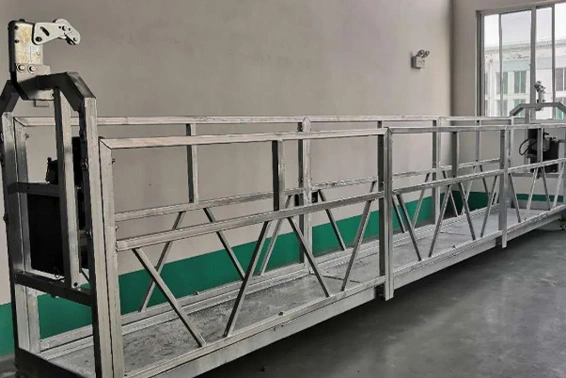
Our platform that is hung can hold up to 500 kg thanks to its two motors. Each LTD50 hoist makes 1.1kW of power, which lets it lift things at speeds of 9 to 11 meters per minute. The normal platform is 5,000 mm long and 690 mm wide, which is enough room for two techs plus their tools and supplies. The platform is 1,180 mm high and has guardrails that meet edge safety standards without making it hard for technicians to move around while working on the facade. The 250-kilogram support system is adjusted by a 750-kilogram counterweight system that keeps the rooftop anchor points from becoming too heavy.
Material Options and Surface Protection
Depending on how the project works, you can choose between steel or aluminum construction. The steel version is 400 kg heavy and is designed to last as long as possible on difficult places. If you choose the aluminum choice, the platform's weight drops to 290 kg, making it much easier to move between building parts and transport. Hot-dip galvanizing is the usual treatment for both types. This adds a zinc layer that stops corrosion for up to 20 years in regular weather. An improved electrostatic spray coating that adds a polymer barrier over the galvanized surface is helpful for coastal projects or industrial settings where chemicals are present.
Safety Lock Fail-Safe Mechanisms
In addition to the main centrifugal stop, the LSA30 has other safety measures that are in line with international standards. When the power goes out, the electromagnetic brake in each hoist motor turns on by itself. This stops the hoist from falling without being controlled before the safety lock even engaged. At both ends of the platform, there are emergency stop buttons that can be pressed by either worker to stop moving right away. Overload monitors in the system stop the hoist from working when the platform weight goes over 550 kg. This gives the system a safety margin before it reaches its rated limit. The design theory behind OSHA 1910.66 and EN1808 certification standards can be seen in these layered defenses.
Maintenance Protocols for Long-Term Reliability
Under normal conditions, safety locks should be inspected every six months. If the equipment is used in a dusty or marine environment, the intervals should be shortened to three months. Inspection teams have to make sure that the brake pads stay thick enough (usually at least 3mm) and that the rotational springs don't show any signs of permanently deforming. A different routine is used to check wire rope. It is visually checked every week for broken strands and its diameter is measured every month to find signs of internal wear. The LTD50 hoists need to have their gear oil changed once a year. They should use ISO VG 220 grade lube to keep the lifting performance stable even when the temperature changes.
Rope Angle Optimization and 30kN Test Procedure
By correctly performing the 30kN load test, you can tell the difference between installations that are safe and those that are compliant. This step checks to see if your ZLP500 Temporary Cradle will keep workers safe in the worst-case situation of failure.
Pre-Test Preparation Steps
Site safety officers should start by making sure that no one who isn't directly testing is in the area below the platform where work is being done. For the test, a measured load of 1,500 kg must be spread out evenly across the platform floor. This load is usually made up of steel plates or water ballast containers. Because the test puts the suspension ropes under a lot of stress that could reveal hidden flaws, they need to be checked for any damage that was there before the test. A structure engineer needs to check the building anchor points to make sure they can handle the shock load that is created when the safety lock is engaged.
Executing the Load Test
Technicians use a mechanical release device to make the platform fall at the same time while it is loaded and hung at a height of at least ten meters. Within 1.2 to 1.8 meters of free fall, the safety lock should go off, stopping the platform for good. During engagement, observers watch to see if the rope slips out of the lock jaws and make sure that the platform's orientation stays stable without swinging too much. The whole stopping process is caught on video to show that it was done correctly and to have as a backup for future inspections. Once the engagement is complete, the platform is slowly lowered to the ground while any damage to the rope surface or safety lock parts is checked.
Troubleshooting Common Test Failures
Most test fails are caused by imbalance of the ropes. If the counterweight or rooftop anchor is not placed correctly, the suspension ropes will not hang straight. This causes an uneven load distribution on the safety lock, which slows activation. Usually, this problem can be fixed by moving the pin points or adjusting the position of the balance. If the lock doesn't work even tho the rope angle is right, it's likely because the brake pads are worn or the gripping surfaces are dirty. Concrete dust or paint overspray on the job site can cover the rope, lowering the friction coefficient below the level needed for a secure connection. This problem can be fixed by cleaning the rope well with mineral spirits and then replacing the brake pads.
Comparing ZLP500 to Alternative Suspended Access Solutions
Knowing how the ZLP500 Temporary Cradle fits into the market as a whole helps procurement teams make choices that balance the need for safety with the need to stay within budget and allow for operational flexibility.
ZLP500 Versus ZLP630 Capacity Comparison
The ZLP630 model has a higher rated load of 630 kg while keeping the same footprint size. This extra space can hold three-person teams or heavier materials like stone cladding panels while the face is being installed. But the higher capacity calls for upgraded hoists with 1.5kW ratings, which uses more power and needs heavier counterweights that make installing them on rooftops more difficult. The ZLP500 is easier to move around on jobs that only need two people, like painting and cleaning windows, where the weight of the materials doesn't need to be too heavy. Both types use the same safety lock technology, but the LSA30 has been changed to handle the heavier working load found in ZLP630.
Temporary Versus Permanent Cradle Systems
Permanent building maintenance units are attached to fixed roof tracks and give commercial towers with regular facade maintenance long-term access solutions. Permanent systems don't need to be set up every time they're used, but they cost a lot up front and need to be built into the structure while the building is being built. The ZLP500 Temporary Cradle is used for projects where building ownership doesn't support the costs of permanent installation or where entry to multiple structures needs to be controlled in a certain order. Because the same set of tools can be used on multiple job sites throughout the year, rental costs are more cost-effective for general builders who are in charge of a wide range of projects. Both types of systems must pass the same load tests and meet the same OSHA or EN standards in order to get safety certification.
Cost-Efficiency Considerations for Procurement
The initial buy price is only one part of the total cost of ownership. Other costs include transporting the equipment, teaching operators, and regular inspections. Because the ZLP500 is modular, it can be broken down into parts that fit inside standard shipping containers. This makes it cheaper to ship things between countries for international projects. Aluminum versions reduce shipping weight even more, which saves money for distributors who serve markets in more than one area. The cost of training is still low because workers who already know how to use any suspended access platform can learn how to use the ZLP500 in just one day of guided practice. Inspection and upkeep costs are closely linked to how often the equipment is used. If the units are properly kept, they will last 15 to 20 years before they need major parts replaced.
Procurement Guide for ZLP500 Suspended Access Equipment
Getting thru the buying process quickly and correctly saves your company from fake goods and makes sure you get the right technical help for the whole lifecycle of the equipment.
Identifying Authorized Manufacturers and Distributors
Genuine ZLP500 equipment has plates that identify the maker and show the production serial numbers, maximum capacity, and approval marks from testing labs. Hebei Xinjiuyi Construction Technology Co., Ltd. has a method that lets purchasing managers check the validity of serial numbers before making purchases official. Authorized wholesalers give proof like ISO9001 quality management certificates, ISO45001 occupational safety certificates, and test results from third-party inspection agencies that are relevant to the product. This paper trail is very important for regulatory inspections and figuring out who is responsible for what after an accident on the job site.
Ordering Process for B2B Buyers
The first step in buying a lot of tools is to look over the technical specs. Our engineering team will compare your project's needs to normal ZLP500 configurations. For projects with unusual building shapes or harsh weather, the length of the platform may need to be changed or the surface treatments may need to be improved. Once the specs are agreed upon, official quotes include prices for the equipment, shipping details, and delivery dates. Prices can be changed for large orders, but the exact terms depend on the size of the order and how it needs to be shipped. Letters of credit or installments based on milestones that are timed to coincide with shipping and delivery confirmation can be used to make international transactions possible.
After-Sales Support and Technical Resources
Professional makers are different from equipment resellers who aren't engineers because they offer full technical help. Xinjiuyi gives users access to detailed operation manuals that include step-by-step instructions for assembly, safety rules, and how to fix common operational problems. When questions about strange site conditions or machine performance come up during the project, our expert team answers them. Equipment performance depends on how readily available spare parts are, especially for projects in remote areas where fast shipping is needed. We keep safety lock brake pads, wire ropes, and hoist motor brushes in stock so that new parts can get to your site within the time frames we agree on, which keeps project delays to a minimum.
Conclusion
The ZLP500 Electric Cradle's safety lock system is an example of how advanced engineering can be used to protect workers in basic ways. By learning about the effects of rope angle and the right way to do a 30kN test, procurement teams and safety officers can turn these technical specs into useful information that they can use when judging ZLP500 Temporary Cradle equipment suppliers. How well your hanging access platform protects workers during normal operations and emergencies depends on how well the load distribution, rope alignment, and safety lock reaction time work together. Construction companies build safety systems that really protect their most valuable asset—the skilled workers who are working at height—by giving priority to equipment that has been tested thoroughly to show that it meets safety standards and by choosing manufacturers that offer full technical support.
FAQ
What is the maximum rope angle for reliable safety lock engagement?
The LSA30 safety lock keeps working properly as long as the rope's angle from vertical stays within 8°. After this angle, lateral forces start to affect how sensitive the centrifugal mechanism is, which could make the stopping distance longer during an emergency. When projects run into building features that make the ropes bend more, they need to move the platforms or add intermediate support points to get the vertical alignment back to normal.
How often should we conduct the 30kN load test?
Different places have different rules, but most safety officials require annual load testing as a basic requirement. Testing equipment every six months is a good way to find worn-out parts before they break on heavy-use items or things that are used in tough environments. No matter how long it's been since the last test, any safety lock that goes off in an emergency while it's being used must be load tested before it can be used again.
Can the safety lock accommodate different wire rope specifications?
To fit traction hoist requirements, the LSA30 design is a perfect match for 8.3 mm steel wire rope. Using different rope diameters or constructions changes the exact clearance between the lock jaws and the rope surface, which could stop the rope from engaging reliably or damage it too soon. To keep the safety certification current, the procurement requirements must clearly check that the ropes are compatible.
Partner With Xinjiuyi for Reliable Suspended Access Solutions
Working directly with Xinjiuyi has big benefits for procurement managers who want to find a reliable ZLP500 Temporary Cradle supplier. Our factory in Cangzhou, Hebei, follows ISO9001 quality standards to make sure that every platform that leaves our production line meets the written requirements. We can help you meet your needs for big purchases by letting you choose the amount you want to buy and when you want it delivered. During the whole buying process, you can still get technical advice that will help you choose the best configuration for your unique use cases. Email our foreign sales team at global@xjy8.com to talk about your needs and get full technical information that will help you decide to buy.
References
1. International Organization for Standardization. (2018). Suspended Access Equipment: Design, Calculations, Safety Requirements and Test Methods. ISO Standards Publication.
2. Occupational Safety and Health Administration. (2020). Powered Platforms for Building Maintenance: Safety Standards and Compliance Guide. U.S. Department of Labor.
3. European Committee for Standardization. (2019). Safety Requirements for Suspended Access Equipment: EN1808 Technical Specifications. CEN Publishing.
4. Construction Safety Association. (2021). Wire Rope Inspection and Maintenance Protocols for Suspended Work Platforms. Industry Safety Manual.
5. National Institute for Occupational Safety and Health. (2017). Fall Protection Systems in Construction: Engineering Controls and Safety Devices. NIOSH Publication Series.
6. Building and Construction Authority. (2022). Technical Guidelines for Temporary Suspended Scaffolds and Cradles. International Construction Standards Review.