What Weight Capacity Can You Expect from Double Ladder Scaffold Frames?
Double ladder walk-through scaffolding does not carry one fixed weight for every frame. Most suppliers state a platform rating, and U.S. duty classes run from light-duty at 25 pounds per square foot to heavy-duty at 75. Xinjiuyi lists its steel double ladder walk-through scaffolding at up to 75 pounds per square foot, verified through destructive load testing. That figure describes the platform, so frame, bay, and full-tower limits still depend on height, bracing, base support, and the supplier's load table. I always confirm the rating for the exact configuration before ordering.
Introduction: Why Load Capacity Matters in Double Ladder Walk-Through Scaffolding
How well it can handle load is up to the machine. One frame can hold a lot of weight on its legs, but the platform, the bay, and the final tower can only hold so much. The outcome may be different based on the size, type of steel, bracing, base supports, height, ground conditions, and laws in the area. This guide can help builders, engineers, buyers, wholesalers, and original equipment makers (OEMs) find the best deals from various sources. Trust load tables that have been written down and engineering data that is specific to the configuration. That's the main thing I want to say. You can't trust words like "heavy duty" or "high strength" until you see proof in a table. In the context of double ladder walk-through scaffolding, documented proof is essential.
How Double Ladder Walk-Through Scaffold Load Capacity Is Determined
Platform, Frame, Bay, and System Ratings
Four grades are often mixed up. The most weight that a deck can hold is known as its platform capacity. Most of the time, this is given in pounds per square foot. The strongest weight that a frame leg can support is known as its "frame capacity" or "leg load." The bay's capacity is equal to the weight of all the frames in a single span. The bracing, jacks, ties, and the whole tower are all part of the system's capacity. It's not true that every frame leg or tower height can hold 75 pounds per square foot just because the platform says it can. OSHA 29 CFR 1926.451 says that a scaffold and all of its parts must be able to hold their own weight plus four times the most weight they were made to hold. In other words, every grade needs its own way to be safe when using double ladder walk-through scaffolding.
Light, Medium, and Heavy-Duty Classes Across Standards
It's likely that most bids will meet three duty classes. Heavy-duty is 75 pounds per square foot, medium-duty is 50 pounds per square foot, and light-duty is 25 pounds per square foot in the U.S. But EN 12811-1 uses six different types of loads, varying from 0.75 kN/m² to 6.0 kN/m². It's about 3.6 kN/m², which is in the middle of EN classes 4 and 5, but it's not the same thing as an EN class grade. Different safety rules and words are used in OSHA, ANSI/ASSP A10.8, EN, and state laws. I believe you should examine the test method behind all of the numbers, not just the highest one.
Why Similar-Looking Frames Carry Different Ratings
There are frames that are the same height and width but can hold different amounts of weight. A 48 mm tube with a 3.5 mm wall is less likely to break than a 42 mm tube with a 2.0 mm wall because the cross-section changes depending on the wall thickness and tube width. It's also important that the steel is good. This is how much Q235 can yield, which is 235 MPa. This is how much Q355 can yield, which is 355 MPa. How the frame holds up against weight is also affected by how well the pins fit together and how far apart they are. Because of these differences, any range of capacities given in a pamphlet, like the ones in this article, should only be used as a guide until they are proven to be correct by official load tables, drawings, and test records.
Double Ladder Walk-Through Scaffolding vs. Alternative Scaffold Types
Versus Single Ladder and Standard Walk-Through Frames
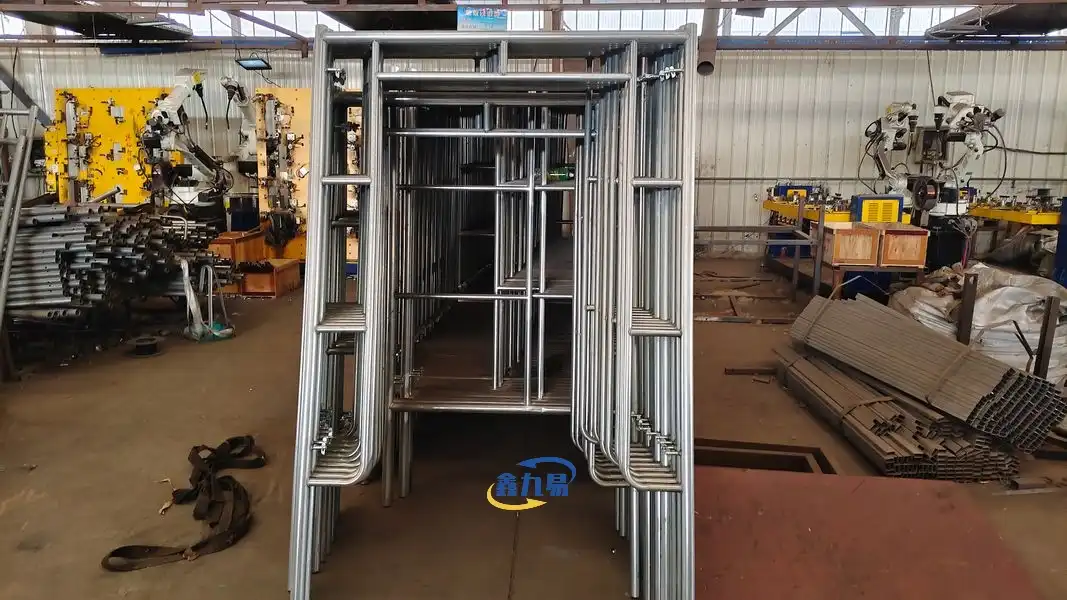
People line up when their shifts change because each ladder frame can only go up in one direction. Most walk-through frames have an open lower bay, but they still need separate ladder attachments. In double ladder walk-through scaffolding, the bottom part stays open and has vertical rungs built into both sides of the frame. A bay on the floor lets people get up from either side and move through it. These cross-braces and screw jacks can be used with Xinjiuyi frames that have either 4 feet or 2 feet between the pins. Labels have different names in different places and from seller to seller, so I first look at the drawings and connection details and then compare the labels.
Versus Mobile Scaffold Towers
Because mobile towers have wheels, they can be used for jobs that need to be moved every shift, like putting up ceilings. It's hard to move around in some places. There must be a restraint on any scaffold that is supported and taller than four times its base width while it is in use. The wheels must also stay locked. Fixed frames on screw jacks are best for staying in one place for longer periods of time, like when working on a factory or a wall. When these frames are put together to make a tower, they can leave room below for people to walk. I only pick mobility when being able to move around saves me more time than the extra rules do.
Steel or Aluminum Frames?
6061-T6 aluminum and steel are both good for different things. Steel is stronger than aluminum (its elastic modulus is about 200 GPa vs. 69 GPa for aluminum), so when big things are put on steel frames, they don't bend as much. Al is only 2.7 g/cm³ dense, while steel is 7.85 g/cm³ dense. This helps move and carry metal better. Every frame that Xinjiuyi makes is made of hot-dip galvanized steel that is at least 60 μm thick and is either Q235 or Q355. They also use 6061-T6 aluminum to make unique frames. Most of the time, steel is best for heavy industrial work, while aluminum might be better for light indoor work. No matter what, I look at the whole plan before I choose a material.
How to Verify the Rated Capacity Before Purchase
Ask for a Configuration-Specific Load Table
A size claim only makes sense if the item you want to buy fits that size. An honest company should give you a load table that lists the maximum height, number of loaded levels, tie spacing, bracing needs, and any wheels or outriggers that are okay. I also check to see if the table has all the parts that come with the package that was quoted. Frames, platforms, pins, guardrails, cross-braces, screw jacks, and entry parts are all part of this. There are holes in a table that could become a problem if you only cover the frame or one height.
Request Material and Test Documentation
If you have a tough job, make sure you have proof to back up what you say. Tests done in the mill prove the chemicals that were used and the yield strength for each batch of goods. Our records of weld checks, load tests, and measurements are used to make sure that the frames are in line with the plans. There are five parts to Xinjiuyi's inspection. They check the weld's strength, the measures' correctness to within ±1.5 mm, the suitability of the material, its endurance to salt spray for more than 500 hours, and its endurance to a 4:1 safety factor. There are more steps to take when the design isn't standard, like when there is a tall tower or heavy material staging. These include documents about compliance and an engineering review that is unique to the project.
A Three-Stage Capacity Checklist
It took me three steps to check double ladder walk-through scaffolding, and each one found a different type of mistake. You should be clear about the purpose, the audience, the size, the height, the material, the finish, the order number, and the shipping needs before you ask for a quote. You should make sure you understand the load tables, bracing and tie layouts, testing, assembly instructions, inspection procedures, warranty terms, and how to get spare parts before you give the go-ahead. Check the numbers, labels, packaging, damage during transport, ability to be tracked, foundation conditions, and who will put it together and look it over before you ship or send it to the job site. It's easier to compare providers if you do these steps in the right order.
How to Use Double Ladder Scaffold Frames Safely at Their Rated Capacity
Spread Loads Evenly and Avoid Impact
The rated capacity is based on the idea that the weight is evenly distributed. Do not stack pallets next to the middle of a span or along one edge. Spread the people, tools, and things out across the site instead. The steady figure may not be the same as the impact load when you drop bricks or a big tool. Only put big things on storage bays that are made for that. Keep piles of things low. Take the weight of the workers, tools, and materials and add them up. Then, look at the ratings for the platform and bay and see how that weight compares. OSHA also says that platforms that are more than 10 feet above a lower level need to have handrails.
Follow a Clear Assembly and Inspection Sequence
How the parts are put together changes how much they can hold. Put base plates or mudsills under the screw jacks after making sure the base is firm and level. Set up and line up the first frames first. Then, add brackets, platforms, guardrails, and parts for getting in and out. Hold the tower steady or tie it down as it rises. A lot of the connection points were made so that they can be put together without any tools. This can make installing on-site up to 40% faster than with regular platform systems. OSHA rules say that a qualified person must oversee the building of the scaffolding and check it over every morning before the work shift starts. Every time I check, I look for rust, bent tubes, and cracks in the joints.
Avoid Practices That Reduce Capacity
A lot of the things we do every day quietly lower our capacity. When you build higher than allowed, take down braces to make room, or mix frames and pins from different sources, they can all change how loads move through the tower. Moving a scaffold with people or things on it makes it more likely that it will fall over or shock someone. Before the ranking was made, adding wind screens or flags didn't change the ranking because they add wind force that wasn't taken into account. I send the new model to the seller or engineer of record first when I need to make changes to a design. Often, small site shortcuts are what make the biggest difference between what is rated and what is done.
How to Choose the Best Double Ladder Walk-Through Scaffolding for Your Project
Define Loads, Height, and Site Conditions
Do the work first, then look at the list. Write down the job's type, the number of workers, the amount of stuff that needs to be moved, the working height, the platform levels, whether the job will be done inside or outside, how mobile the workers need to be, how long the double ladder walk-through scaffolding is expected to last, and any local rules. Next, check that the frame and base are the right sizes for the site. The length of Xinjiuyi frames is 1800 mm or 1930 mm, which is about 71 to 76 inches. The width is 950 mm, 1219 mm, or 1250 mm, and the height is 1524 mm to 1931 mm. You can also get them in any size you want. Make sure there are clear paths to the storage areas and enough space in the bay for things to move around.
Compare Total Cost of Ownership
It's not all about the unit cost. Keep track of how many hours it took to build, how much the freight weighed, how long the finish will last, how many fixes will be needed, and how much the project will be worth when it's time to sell it. It stops corrosion in wet and marine places if you hot-dip galvanize at 60 µm or higher. This means you don't have to paint or shut down as often. Steel frames last longer in factories where they're used a lot, even though aluminum frames may be easier to move. Plan ahead and get spare parts for standard and special items at different lead times. For providers to compare choices, I want them to look at the same things, not just price: size, finish, and paperwork.
Work with a Qualified Double Ladder Scaffold Manufacturer
It's not enough for a good maker to just send frames. People who work at Hebei Xinjiuyi Construction Technology Co., Ltd. live in the Xian County Development Zone of Cangzhou. They have ISO 9001, ISO 45001, and ISO 14001 certifications, and they can make goods that are exactly the size, material, and style that you want. To make sure the calculations for the loads are correct, our team draws and renders designs, helps with installation, and trains the crew on-site. Customers from all over the world can get help from us after the sale to make sure that service and quality are the same for all of their building and shipping projects.
Conclusion
The most weight that can be put on a double ladder walk-through scaffolding is not set in stone. The platform, frame, bay, and full-tower types can hold different amounts of weight. OSHA wants a safety margin of four times the maximum intended load. Each EN 12811-1 load class has a duty class of 25, 50, or 75 pounds per square foot. These show why buyers should look at test methods instead of signs when making a choice. The ranking can be changed by the tube's size, wall thickness, steel grade, supports, height, base conditions, and wind exposure. You can also use steel and aluminum for different things. To back up the number, all you need is a configuration-specific load table, mill reports, and load-test records. The grade is only useful if the workers spread out the loads, put them together correctly, and check every shift.
FAQ
1. Is there one weight capacity for every double ladder scaffold frame?
It depends on the base's size, the tubes' size, the type of steel used, the supports, the height, the bracing, and the rule that is in place. As Xinjiuyi says, its steel frames can hold up to 75 pounds per square foot. However, I still use my own load table to make sure.
2. How do I calculate the combined load on a platform?
Figure out how much the workers, tools, and materials weigh, then divide that number by the platform's width. Four people who weigh 200 pounds each work in 24 square feet. There are also 400 pounds of things spread out in that area. Compare that number to the platform and bay's reviews.
3. Does extra height reduce scaffold stability?
Yes. Workers must be held back by safety straps when a supported scaffold is wider than four times its base. Wind is also more likely to hit larger buildings. Ties, braces, and props help keep tall towers safe and within the limits that were planned for them.
4. Can I mix components from different suppliers?
I believe you should not do it. There are different pin spacing, tolerances, and fits for each connector, and a load table only shows the parts that have been tested. As well as test results, compliance papers, models, and instructions on how to put the parts together, your service should give you these things.
Request a Double Ladder Walk-Through Scaffolding Quotation from Xinjiuyi
An ISO 9001, ISO 45001, and ISO 14001 company in Cangzhou, Hebei, is called Xinjiuyi. It helps shippers, builders, and dealers who need to know they can trust a company that makes double ladder walk-through scaffolding. Tell us how much you need, what kind of material you want, how many items you want, and where you'd like them delivered. Our team will look at the load data, make drawings and a quote, and then send them to you. They will also suggest a standard or custom configuration. Visit xjy8.com or email global@xjy8.com to learn more.
References
1. Occupational Safety and Health Administration, Safety and Health Regulations for Construction: Scaffolds (29 CFR 1926 Subpart L), 1996
2. American National Standards Institute and American Society of Safety Professionals, ANSI/ASSP A10.8 Scaffolding Safety Requirements, 2019
3. British Standards Institution, BS EN 12811-1 Temporary Works Equipment: Scaffolds, Performance Requirements and General Design, 2003
4. Occupational Safety and Health Administration, OSHA 3150 A Guide to Scaffold Use in the Construction Industry, 2002
5. Standardization Administration of China, GB/T 1591 High Strength Low Alloy Structural Steels, 2018
6. ASM International, ASM Handbook Volume 2: Properties and Selection: Nonferrous Alloys and Special-Purpose Materials, 1990