Tower Crane Base Enclosure: Types, Benefits, Applications and Selection Guide
The tower crane base enclosure is a modular perimeter safety system designed to safeguard the foundation zone of a tower crane at active construction sites. It safeguards electrical equipment from theft, unlawful access and protects ground-level workers from whirling parts. They are made from galvanized steel frames and perforated mesh panels and comply with all national and international safety regulations. The correct foundation barrier, whether it’s a single high-rise project or a rotation of equipment over dozens of sites, has a direct impact on your safety acceptance results and long-term equipment protection.
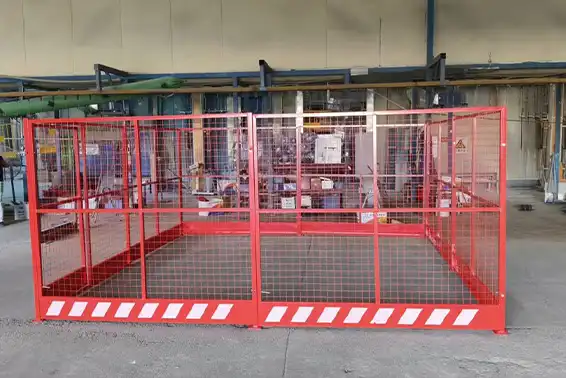
Understanding Tower Crane Base Enclosures: Purpose and Key Features
What Problem Does It Solve?
One of the most hazardous places on any industrial site is the area around a tower crane foundation. Workers and visitors may accidentally walk inside the swing radius without a physical boundary. Copper cabling and control panels are susceptible to theft. A well made crane foundation guard gives a consistent limited zone, and deals with all three risks at once.
Core Safety Components
Every effective enclosure should include the following elements working together:
- Warning signs with high-contrast yellow and black markings that communicate restricted access at a glance
- Anti-climbing baffles that prevent workers from scaling panels to take shortcuts through hazardous zones
- Toe boards positioned at ground level to stop tools, debris, or materials from rolling underneath the barrier
These components are not optional add-ons. Safety acceptance inspectors in most jurisdictions require all three to be present before a site receives clearance to operate.
Structural Standards and Impact Resistance
Enclosures fabricated from Q235 or Q345 galvanized carbon steel deliver proven structural strength. Independent testing shows that quality panels withstand impact forces up to 1,000 joules without catastrophic deformation. Mesh apertures are sized to prevent a person from reaching through, aligning with ISO 13857 guidance on safe distances. Salt spray corrosion resistance exceeding 500 hours under ASTM B117 conditions confirms long-term durability of the tower crane base enclosure in outdoor environments.
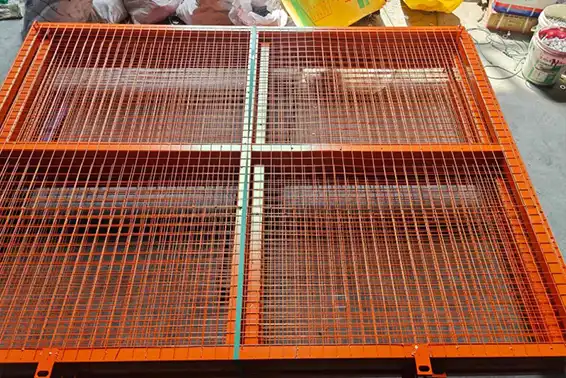
Types of Tower Crane Base Enclosures: Materials, Designs, and Configurations
Fixed vs. Modular Designs
Fixed enclosures are cast or welded to a foundation permanently. They give rigidity, but once a work is done they cannot be moved. Modular bolt-together systems make more sense for contractors who are operating at many different sites. Panels are easy to build using standard hardware and hand tools, and can be taken down and transported in hours, not days.
Material Comparison
The three most common material categories each carry distinct trade-offs:
- Galvanized steel pipe frames with perforated plates provide the best balance of structural strength, corrosion resistance, and weight. Hot-dip galvanizing combined with baked powder coating gives a service life of 5–10 years under regular outdoor conditions.
- Welded mesh frames with angle steel reinforcement suit projects where weight reduction matters more than impact resistance. They cost less upfront but may deform after several relocation cycles.
- Concrete or masonry barriers appear on long-duration infrastructure projects where permanence is required. They are not practical for multi-site contractors due to the cost of demolition.
Galvanized steel pipe frames remain the preferred choice for procurement teams balancing durability, portability, and cost across multiple project cycles.
Standard Dimensions and Customization
Most tower crane foundations are 2,000 mm by 1,500 mm in width, with a conventional height of 1,800 mm. For example, in group crane operations or in international sites where the mast base specifications are not standard (as is the case, for example, with OSHA 1926 or EN requirements), businesses such as Xinjiuyi may make width and height adjustments to fit a particular site.
Applications and Industry Use Cases for Tower Crane Base Enclosures
High-Rise Urban Construction
In dense city environments, the gap between public walkways and heavy machinery is often just a few meters. A tower crane base enclosure creates a clear physical and visual boundary that protects pedestrians and workers simultaneously. Projects in New York, Chicago, and Houston routinely require this type of perimeter control to satisfy local building department inspections.
Infrastructure and Remote Sites
Bridge building, wind turbine installations, and interstate interchange projects are typically nocturnal, in unmanned or low-supervision circumstances. The structure here also protects hydraulic lines, electrical panels and copper cabling from theft and interference from animals, hazards that are handled differently at urban locations.
Overseas Projects and OSHA Compliance
If Chinese contractors are operating in the Middle East, Southeast Asia or Latin America and are sourcing locally, they may face longer lead times and higher rates. A whole set of crane foundation barriers with English warning signs, hot-dip galvanized frames and compliance with OSHA 1926 or EN verification, sent directly from a manufacturer in China may save a lot of procurement time and cost. Also, tower crane rental companies might benefit by including enclosures with every rental unit, therefore differentiating its service offering with little administrative expenditures.
Selection Guide: How to Choose the Ideal Tower Crane Base Enclosure?
Evaluate Site-Specific Requirements First
Before receiving quotations, describe the size of your foundation, the number of project locations where the system will rotate, the projected term of usage, and any local regulatory requirements. This details will decide if ordinary panels will do the trick or whether you need to go custom sized.
Key Criteria for Procurement Decisions
Here are the core factors that safety managers and procurement teams weigh when selecting a system:
- Regulatory compliance: Comply with the appropriate standards - GB, OSHA 1926, EN - depending on the project region. Request 3rd Party Test Results Proof of salt spray and impact testing required.
- Material and quality of coating: Outdoor environments: Hot-dip galvanizing + powder coating vs. paint alone finishes Test specimens for cross-cutting testing of coating adhesion
- Modular compatibility: Panels should be able to reliably connect to one another after a few disassembly cycles without warping. Ask the vendors what the dimensional tolerances are. The accepted standard is Seamless panel to panel assembly +/- 2 mm.
- Availability of Spare Parts: Individual panels and connectors need be purchased separately. A system where if one part breaks down the entire system requires replacement is costly in the long run."
These criteria help teams avoid the most common procurement mistake: choosing on upfront price alone while ignoring lifecycle cost and compliance documentation.
Rental vs. Purchase
For contractors with fewer than three active sites per year, renting the tower crane base enclosure may reduce capital outlay. For multi-site contractors or crane rental companies building a service package around their fleet, purchasing modular panels and rotating them across projects delivers a far lower cost per use over time.
Installation and Maintenance Best Practices for Tower Crane Base Enclosures
Pre-Installation Site Assessment
Before assembly begins, measure the foundation perimeter accurately and confirm ground conditions. Uneven terrain may require shimming at the base of toe boards to eliminate gaps. Identify the access gate position before fixing panel layout—relocating it after assembly wastes time.
Step-by-Step Assembly Checklist
Assembly with standard hand tools typically takes two to four workers less than half a day. Follow this sequence for consistent results:
- Before you start, lay out all panels and hardware to make sure no parts are missing.
- First connect the corner portions to form the perimeter shape.
- Insert straight panels between corners, tightening nuts to torque values provided in installation instructions
- The last phase is to attach warning signs, anti-climbing baffles, and toe boards
- Check for gaps larger than the limit of the mesh aperture by walking around with an inspector.
Routine Maintenance and Longevity
After each project, check panels for paint damage, bending frame parts and missing hardware before storage. If any exposed steel is visible, touch up with a zinc-rich primer to prevent corrosion in storage. Panels that are kept flat in a dry environment preserve dimensional correctness for many more deployment cycles than panels that are left upright outside. Individual broken pieces may be replaced rather than complete systems, which makes the long-term costs of maintenance predictable.
Conclusion
Protecting the foundation zone of a tower crane is not a formality; it is a direct element in site safety results, regulatory compliance and equipment security. Properly erected and maintained, the correct tower crane base enclosure decreases exposure to accidents, passes safety inspections on the first review and rotates over numerous projects to save per-site expenses. The most crucial choice in this procurement category is choosing the right enclosure type for your site circumstances and regulatory needs, whether you’re working on local high-rise developments or multinational infrastructure projects.
FAQ
Is the enclosure compatible with all crane brands?
Sure. The modular panel system has adjustable connections that work with mast parts from key manufacturers like as Potain, Liebherr and Zoomlion. Non-standard foundation footprints may be custom sized.
How does the structure handle high wind speeds?
The perforated plate mesh has been designed with a determined void ratio to minimize the wind load on the panels to avoid the sail effect that destabilizes solid barriers on open locations.
Can panels be relocated mid-project?
Yes. The bolt-together design allows for disassembly and relocation when site plans change, and does not need specialist equipment, merely normal hand tools.
What surface treatment options are available?
Standard is hot-dip galvanizing with yellow-black baked powder coating. Projects are offered under certain area safety norms with custom colors and warning signs in local languages.
How do I verify a supplier's quality credentials?
Request ISO 9001 certification, third-party salt spray test reports (ASTM B117), impact resistance test data, and dimensional accuracy records. Reputable suppliers provide these documents before purchase.
Partner with Xinjiuyi for Your Next Tower Crane Base Enclosure Project
Xinjiuyi is an ISO 9001, ISO 45001 and ISO 14001 Certified manufacturer and supplier of tower crane base enclosure. We can fully customize our products for worldwide applications. Our staff assists you from technical specification through to delivery and on-site coaching. Please contact us immediately to discuss your needs, get product drawings or to obtain a quotation. For the whole product portfolio, please contact our export team at global@xjy8.com.
References
1. Occupational Safety and Health Administration. Construction Industry Standards: 29 CFR 1926. U.S. Department of Labor, 2022.
2. International Organization for Standardization. ISO 13857: Safety of Machinery – Safety Distances to Prevent Hazard Zones Being Reached by Upper and Lower Limbs. ISO, 2019.
3. American Society for Testing and Materials. ASTM B117: Standard Practice for Operating Salt Spray (Fog) Apparatus. ASTM International, 2019.
4. Construction Industry Institute. Safety Performance Report: Crane Operations and Foundation Zone Hazard Control. CII, 2021.
5. European Committee for Standardization. EN 13374: Temporary Edge Protection Systems – Product Specification and Test Methods. CEN, 2018.
6. National Institute for Occupational Safety and Health. Crane Safety on Construction Sites. NIOSH Publication No. 98-126, U.S. Department of Health and Human Services, 2020.