Rebar Coil Rack vs. Traditional Steel Coil Storage: Which Features Matter?
When comparing a rebar coil storage cradle rack against traditional steel coil storage, the differences go far beyond appearance. Cradle racks are purpose-built with arc-shaped saddles, full-seam welding, and anti-roll positioning to hold coiled rebar securely without deformation. Traditional flat racks or pallet stacking methods lack these structural safeguards, increasing risks of coil roll-off, moisture damage, and workplace injury. For B2B procurement professionals sourcing storage equipment for rebar processing sheds, tower crane zones, or secondary material yards, understanding which features truly matter can directly affect site safety, material integrity, and long-term operational costs.
Understanding Rebar Coil Storage Solutions
What Is a Cradle Rack?
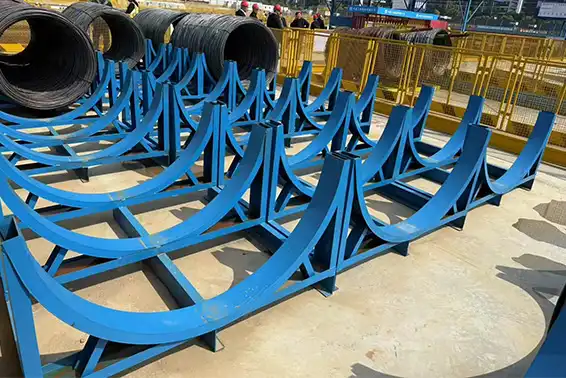
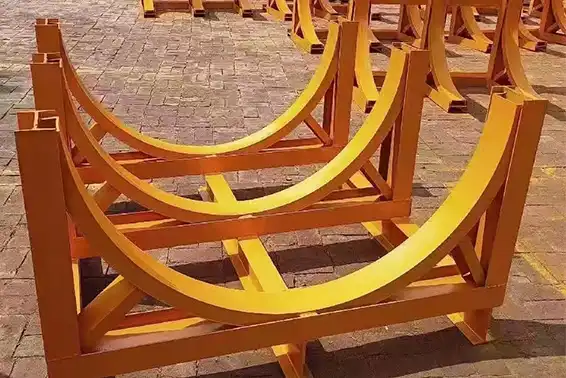
Steel coil cradle racks are strong storage units that are made to hold rebar that has been wound up in a curved shape. Its arc-shaped seat properly distributes the weight across the coil's surface, which prevents the "egg-shaping" bending that happens when coils sit on flat surfaces for a long time. Things don't get wet or dirty with mud because the shape keeps them off the ground.
What Does Traditional Storage Look Like?
Pallets, flat wooden bunks, or simple horizontal frame racks are the traditional ways to store steel bars. For many years, this was how things were always done in warehouses. They can hold lighter items or things that won't be needed for a long time, but heavy rebar coils, especially ones that are 8 mm to 32 mm in diameter and weigh up to 3–5 tons each, don't do well in them.
Where the Gap Becomes Clear
Things that are stored in the old-fashioned way get worn out faster when forklifts move them and they're left out in the weather. When coils are loaded and emptied, edges with thin paint are more likely to rust, which puts workers at risk of getting hurt. When procurement teams look for sites with a lot of turnover, they quickly learn that the cost savings they saw at first from old methods are canceled out by accidents that damage materials and cause downtime.
Key Feature Comparison: Rebar Coil Rack vs. Traditional Storage
Structural Design and Load Integrity
To make the rebar coil storage cradle rack from Xinjiuyi, they used 100# channel steel with a web thickness of about 3.2 mm and added 50 mm × 50 mm square and rectangular tube supports for extra strength. It's 1500 mm long, 1500 mm wide, and 650 mm high, and each seat can hold 5 tons. Racks with a flat frame that have been around for a long time tend to be made of lighter forms and aren't made to handle heavy coil contact loads.
Surface Protection and Corrosion Resistance
It is known that cheap storage racks with thin coats of paint will break down in places that are hot or near the coast. When Xinjiuyi coats all the structure's sides with a coating that stops rust, they use a method that tries for even micron-level coverage. Most of the time, traditional ways of storing things only use one coat of paint, and the thickness of the layer isn't always written down. In other words, steel can rust within a few months of being used outside.
Safety Compliance and Anti-Roll Design
Coil roll-off is the most common type of material handling accident on building sites, and it's always possible to avoid it. The arc-shaped support and built-in anti-roll placement in steel coil racks made just for them keep each coil safe, even when a crane or truck moves or lifts the racks. In traditional stacking, there are no mechanical restraints. Instead, loads are held in place by hand, which is always marked as not enough for loads over 1 ton by OSHA material handling guidelines.
Benefits of Using Rebar Coil Storage Cradle Racks over Traditional Storage
Three things get better when you switch from normal stacking to a special cradle system: you save space, workers are safer, and maintenance costs go down. If you work with or distribute rebar, this type of rack will help in the following ways:
- Space utilization: The standardized 1500 mm × 1500 mm footprint allows racks to be positioned in predictable grid patterns within processing sheds, making inventory counts faster and forklift aisles predictable. Traditional ad hoc stacking often wastes 20–30% of floor space due to irregular coil placement.
- Reduced material damage: Elevating coils 650 mm off the ground keeps them clear of standing water, mud, and ground-level debris. Studies in industrial warehousing consistently show that ground-contact storage accelerates surface corrosion by 2–3× compared to elevated storage in comparable environments.
- Lower long-term maintenance: Full-seam welding and burr-free edge finishing reduce both structural fatigue and worker contact injuries. Traditional racks with partial welds and unfinished edges generate recurring repair and liability costs.
Racks can be set up in processing sheds in grid designs that are easy to guess thanks to the standard 1500 mm × 1500 mm size. This makes it faster to count inventory and safer for forklift aisles. Ad hoc stacking is a method that wastes 20–30% of floor space because of how the coils are placed.
Less damage to the material: being 650 mm above the ground keeps the coils from getting wet, muddy, or broken when they are at ground level. Studies done in industrial warehouses have shown over and over that storing things on the ground speeds up surface rust by two to three times compared to storing things on top of the ground in the same conditions.
Welding the whole seam and finishing the edges without burrs lowers both structure fatigue and worker contact injuries, which means less maintenance over time. Old rebar coil storage cradle rack with rough edges and seams that are only partially welded are dangerous to use and cost a lot to fix.
Choosing the Right Storage Solution for Your Business
Evaluating Load and Safety Requirements
Find out what the largest coil is that your site can handle per unit before you choose a way to store it. If your standard rebar coils weigh between 3 and 5 tons, you should only use racks that have written records of static load tests. Ask your provider for a 3-ton static load certificate. This is something you need to do.
Assessing Supplier Credibility
You can depend on your supplier for a lot more than just the quality of the product. How well a storage solution works on your site depends on how fast it arrives, how well it's packed, and how helpful the company is after the sale. The company Hebei Xinjiuyi Construction Technology Co., Ltd. has ISO 9001, ISO 45001, and ISO 14001 certifications, and every product they make has a quality control and workplace safety system built in. This gives buying managers a good place to begin when looking at sources.
Matching Products to Site Conditions
A rack that works well in a room where rebar is processed might not work as well in a yard where secondary materials are stored outside, where the temperature and air flow can change. Check the covering grade, the rack's inner circle to make sure it fits your coil sizes (the normal range is 1200 mm to 1500 mm), and the rack's ability to work with carts. Modules and pieces that are simple to take apart let them be used at different stages of a project without having to buy new tools.
Installation and Maintenance Guide for Rebar Coil Storage Cradle Racks
Site Preparation and Assembly
Cradle racks should be set up on flat, firm ground that can hold a range of weights. You don't have to bolt a single-level floor, but it's a good idea in places where there is a lot of vibration, like near heavy machinery. It's easy to put together; each modular unit links with standard screws, and two people can do it in minutes. None of the tools are needed.
Routine Inspection Protocol
During normal use, check the coating, the saddle contact surfaces, and the structural joints every 30 days to make sure they are still in good shape. Check the joint for cracks, rust that shows on the outside, or warping in the arc support channels. Make a note of what you find and plan to fix the protected covering before the rust gets to the metal underneath.
Troubleshooting Common Issues
If a rack is full and leans to one side, make sure the ground hasn't moved under the base frame before you decide the structure is broken. Lean problems on construction sites are more often caused by uneven ground than by rack defects. If a weld breaks or bends a lot when it's fully loaded, don't use it anymore and call the company that made it.
Conclusion
You shouldn't just look at price when choosing between a custom steel coil cradle system and a rebar coil storage cradle rack or old-fashioned ways to store things. It's also about how much risk you're willing to take, how to keep operations running, and how to protect materials. Normal storage isn't as good as cradle racks when it comes to load capacity, safety against rolling, moisture protection, and flexible adaptability. When wholesalers, processing companies, and buying teams deal with a lot of rebar, the right way to store it cuts down on both waste and accidents at work over the life of the equipment.
FAQ
What is the maximum load capacity per cradle?
Standard models from Xinjiuyi support up to 5 tons per cradle. For specialized industrial applications requiring higher capacity, custom-engineered configurations are available on request.
Can these racks be relocated during an active project?
Yes. The modular, dismantlable design allows fast disassembly and relocation to match changing site layouts. No specialized tools are required, and the compact disassembled form reduces transport volume per load.
Do they require floor anchoring?
For single-level use, anchoring is optional but recommended in high-vibration environments. Multi-tier configurations require heavy-duty chemical anchors for operational and seismic stability.
Are they suitable for outdoor storage?
Yes. Xinjiuyi applies a dedicated rust prevention coating designed for outdoor exposure. For sites in coastal or high-humidity regions, hot-dip galvanization is available as an upgrade finish.
How do cradle racks improve worker safety compared to traditional stacking?
The arc-shaped saddle and anti-roll positioning prevent coil movement during lifting and handling operations, eliminating the roll-off accidents most commonly reported with flat-surface stacking methods.
Request a Quote from Xinjiuyi — Trusted Rebar Coil Storage Cradle Rack Manufacturer
Xinjiuyi has been making building tools for more than 20 years, so every item they ship is made with care. Rebar coil storage cradle racks come in both standard and special sizes, which you can buy from us. We use full-seam welding and have quality methods that are ISO-certified. No matter if you need to find a single SKU for your distribution counter or finish a whole processing room, our team is ready to help. To find out about prices, specs, or to set up a personal meeting, you can email us at global@xjy8.com or visit xjy8.com.
References
1. Rack Manufacturers Institute (RMI). Specification for the Design, Testing, and Utilization of Industrial Steel Storage Racks. Material Handling Industry of America, 2012.
2. Occupational Safety and Health Administration (OSHA). Materials Handling and Storage. U.S. Department of Labor, 2002.
3. European Committee for Standardization. EN 15512: Steel Static Storage Systems — Adjustable Pallet Racking Systems — Principles for Structural Design. CEN, 2020.
4. European Committee for Standardization. EN 15635: Steel Static Storage Systems — Application and Maintenance of Storage Equipment. CEN, 2008.
5. Pham, C. H., & Hancock, G. J. "Experimental Investigation of High-Strength Cold-Formed Channel Sections in Combined Bending and Shear." Journal of Constructional Steel Research, 2009.
6. International Organization for Standardization. ISO 9001:2015 Quality Management Systems — Requirements. ISO, 2015.