How to Choose the Right Construction Site Protection Canopy for Your Project
Choosing the right construction site protection canopy starts with understanding your site's specific hazards, span requirements, and regulatory obligations. The best overhead safety system should be able to handle the amount of weight you need it to, be in a windy area, and be used often. Our steel-framed protective canopy systems at Hebei Xinjiuyi Construction Technology Co., Ltd. are designed to deal with all of these factors, from modular assembly that allows them to be used on multiple projects to dual-layer surface treatment that prevents corrosion over time. Making the right choice here will protect your team, your tools, and your project schedule.
Understanding Construction Site Protection Canopies: Types and Key Features
Before you pick an overhead security system, it's helpful to know what makes each type unique. Each style works well for a different site.
Fixed vs. Modular Systems
Buildings with fixed roofs stay put for good, and they work well on long-term high-rise sites in towns. Xinjiuyi's modular systems can be put together by a four-person crew in 20 to 30 hours thanks to standard coupling connections. As the job site conditions change all the time and time is of the key, this is a big help.
Portable and Rental Options
For short-term work, like when concrete is poured or tools are set up, portable booths are great. While renting can save you money on up-front costs, they often come with hidden fees for things like damage, non-standard sizes, and limited customisation. For procurement teams that are in charge of more than one project a year, having a modular system generally saves them money after eight or more uses.
Key Safety Features to Verify
Certain types of overhead protection are not all created in the same way. Make sure the following things are present and written down before you agree to buy something:
- Structural steel grade: Q235B or Q345B steel with verified weld integrity reports.
- Impact resistance: Panels rated to withstand falling objects; heavy-duty decks handle live loads from 150 to 300 lbs/sq.ft.
- Wind load rating: Systems should resist gusts up to 120 km/h, equivalent to a Category 1 hurricane level.
- Surface treatment: Hot-dip galvanization meeting a minimum 85-micron zinc coating thickness per ASTM A123 standards.
- Compliance certifications: Alignment with OSHA Falling Object Protective Structures (FOPS) requirements and EN 12811-1 for temporary structures.
These features directly show if a canopy will pass safety checks on the job site and keep your team safe in real life.
Criteria for Selecting the Right Canopy Based on Project Needs
Once you know the basics, the next step is to make sure the canopy fits perfectly with your project's shape. This choice is based on a number of factors.
Environmental Conditions and Span Requirements
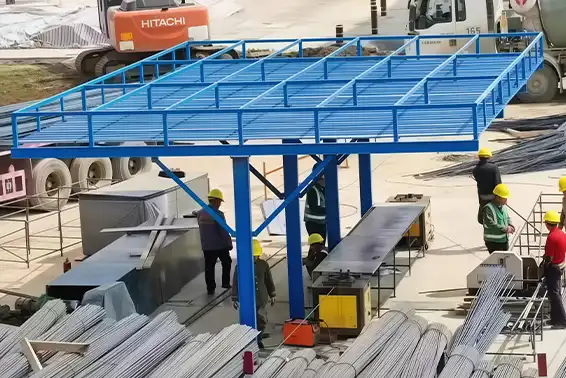
Finishes that don't rust are needed in seaside areas or industrial areas with a lot of humidity. The two-layer system used by Xinjiuyi—hot-dip galvanizing and electrostatic powder coating—makes a barrier that can protect against salt spray and long-term exposure to water. Our modular construction site protection canopy system can span anywhere from 6 m to 18 m, with standard column configurations that come in lengths of 6,000 mm and 9,000 mm and widths of 4,000 mm to 6,000 mm. All of these can be changed to fit your site drawings.
Usage Frequency and Reuse Potential
If your company is in charge of several projects at the same time, the rate of reuse is no longer just an operational variable, but also a financial one. A cover system that can be taken apart and put back together eight or more times with less than 5% component loss will save you money compared to single-use options. Before you sign a purchase agreement with a supplier, make sure you get written information on cycle tolerance.
Procurement Checklist for Buying Teams
Here is a useful list to help you with your sourcing:
- Confirm the supplier provides a certified wind load test report.
- Request module dimension drawings to verify fit against your site's master plan.
- Check whether screw jack bases accommodate terrain slopes up to 15 degrees.
- Verify that warning markings and safety signage meet local civilized construction standards.
- Confirm lead time commitments and whether modular coupling systems require specialized tools.
– Ask for drawings of the module's dimensions to make sure they fit with the general plan for your spot.
— Check to see if screw jack bases can handle slopes of up to 15 degrees.
— Make sure that the warning signs and markings meet the civilized construction standards in your area.- Make sure you know how long the wait time is and if modular connection systems need special tools.
Installation, Maintenance, and Compliance: Ensuring Long-Term Performance
A well-specified canopy still fails if it is installed incorrectly or allowed to deteriorate between projects.
Best Practices for Safe Installation
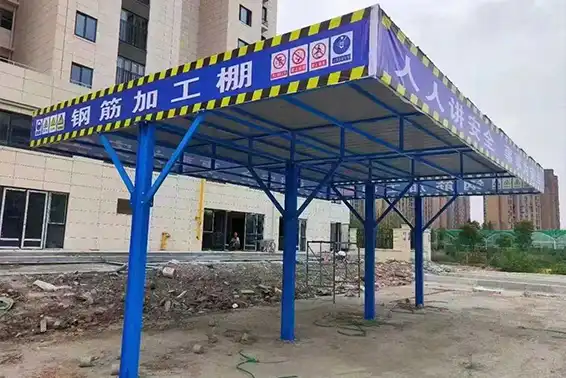
Xinjiuyi's construction site protection canopy single-column design reduces ground space occupation by up to 40% compared to multi-column systems, giving forklifts and cranes clear movement paths beneath the protective deck. Adjustable screw jacks manage uneven terrain without requiring site grading work in advance. For the first installation, an on-site guidance team can walk your crew through the assembly sequence to prevent joint misalignment.
Routine Maintenance Schedule
Steel structures require periodic attention to remain compliant and structurally sound. A certified safety officer should conduct a visual inspection weekly. After any extreme weather event or impact incident, a full structural audit is necessary before the canopy returns to service. Specific maintenance tasks include:
- Checking weld points at load-bearing connections for signs of fatigue or cracking.
- Inspecting the powder coating surface for chips or rust initiation points.
- Verifying that fasteners remain torqued to specification after vibration from adjacent heavy equipment.
Compliance Documentation You Must Have on File
Regulatory inspections on active construction sites frequently request proof that overhead protection systems meet applicable codes. Keep the following on file: the supplier's test report for static load capacity, the galvanization thickness verification record, and any EN 12811-1 or OSHA FOPS compliance declarations. Missing documentation can trigger work stoppages — a risk no project manager needs.
Comparing Construction Site Protection Canopies: Making Cost-Effective Choices
Once your options are really limited, the cost analysis will make all the difference.
Purchase vs. Rental: The Long View
The rental fees for temporary overhead security may seem low at first, but they add up quickly over the course of a job that lasts several months in a city. For buying managers who run centralised purchasing programs, a modular canopy system that can be moved from one project site to another lowers the cost of protection per square metre over the course of three to five years.
Supplier Reputation and Delivery Reliability
Just as important as the product specs is how the construction site protection canopy supplier has done in the past. Check the manufacturer's track record of success, ask for examples of past projects they've worked on with clients like yours, and make sure they are ISO 9001 certified for quality control. Xinjiuyi is certified by ISO 9001, ISO 45001, and ISO 14001, which means they have organised ways of taking care of quality, safety, and the environment. Also, the canopy needs to get there on time; if it shows up after the critical path action has started, it won't protect anything.
Innovative Design Ideas and Future Trends in Construction Site Protection Canopies
In the category of overhead protection, systems that do more than just stop things from falling are becoming more common.
Modular Systems with Safety Monitoring Integration
Newer systems have load sensors and tilt monitors built into the roof frame. These tell the builders in real time how stressed the structure is. Standard buying guides don't yet list this technology, but you can get your site ready for adding sensors later without having to change the structure if you choose canopy designs with conduit channels that are easy to get to.
Eco-Friendly Materials and Recyclable Components
Green building rules are changing how big construction projects buy things in a bigger way. At the end of their useful life, galvanised steel parts can be recycled in full. Powder coatings that don't contain heavy metals are in line with rising environmental standards in both the U.S. and foreign project markets.
Warning Color Compliance and Visual Management
For the safety of pedestrians and to meet regulations, urban job areas need clear visual boundaries. So, single-column canopy designs with bright paint for warnings are becoming the norm. For major city building projects that follow the rules for civilised construction, our electrostatic powder coating comes in safety yellow and orange.
Conclusion
Make sure that the technical specs of the construction site protection canopy you want to buy match your site's span, wind exposure, geography, numbers of times it will be used, and compliance standards. There are many risks that can happen in places where materials are being worked on, stored, and walked on. A steel-framed modular canopy with tested load rates, a documented surface treatment, and a flexible column plan can keep everyone safe. Your project stays on track and your team is safe when you make this choice after getting all the scientific information you need.
FAQ
What safety features are most important in a site canopy?
The four things that can't be changed are the structural steel grade, the weld soundness documents, the wind load rating, and the thickness of the surface coating. Any cover put up over a busy work area should have a load test report that can be checked and should meet OSHA FOPS standards or EN 12811-1 standards for temporary safety structures.
How long does installation typically take?
With a pre-engineered modular system, a skilled four-person crew can put up 20 to 30 linear feet of wall per hour. Putting up a normal 6 m x 9 m canopy can take one working day, but it depends on the terrain and how easy it is to get to the spot.
Can canopies be customized for non-standard site dimensions?
Yes. Full-dimensional tailoring is available from reputable makers. Before production starts, Xinjiuyi's engineering team looks over your site drawings to make sure that the column placement, beam size, and load distribution are correct. This makes sure that the system delivered exactly matches your floor plan.
How often should structural inspections occur?
It is standard for a trained safety worker to do visual checks once a week. After any harsh weather event, a major impact event, or eight or more rounds of taking apart and putting back together, the structure needs to be fully inspected.
Is the steel frame recyclable at end of service?
Yes, all galvanized Q235B steel parts can be recycled. This helps meet environmental certification requirements for projects that need to keep track of materials throughout their entire lifecycle.
Get a Custom Quote from Xinjiuyi — Your Trusted Construction Site Protection Canopy Manufacturer
Xinjiuyi makes overhead protection systems that are made to work on real job sites. They use certified materials, put them together in modules, and offer engineering support from the first question to the final installation. Our team is ready to look over your site drawings and come up with a solution that meets your safety and compliance needs, whether you need a standard layout or one that is tailored to your project. To get specs and a project price, email us at global@xjy8.com or go to xjy8.com right now.
References
1. Occupational Safety and Health Administration (OSHA). Construction Industry Regulations: Falling Object Protection Standards (29 CFR 1926). U.S. Department of Labor, 2021.
2. European Committee for Standardization. EN 12811-1: Temporary Works Equipment — Scaffolds — Performance Requirements and General Design. CEN, 2003.
3. American Galvanizers Association. Hot-Dip Galvanizing for Corrosion Protection: A Specifier's Guide. AGA, 2020.
4. ASTM International. ASTM A123/A123M: Standard Specification for Zinc (Hot-Dip Galvanized) Coatings on Iron and Steel Products. ASTM, 2017.
5. National Fire Protection Association. NFPA 701: Standard Methods of Fire Tests for Flame Propagation of Textiles and Films. NFPA, 2019.
6. Construction Industry Institute. Best Practices for Temporary Structure Safety Management on Active Construction Sites. CII Research Report, 2018.