How a Working Canopy Creates a Safer Outdoor Workspace for Carpenters
A carpenter working canopy creates a safer outdoor workspace by placing cutting, assembly, and storage under one protected, clearly defined shelter. It keeps rain off power tools and lumber, limits the spread of dust and wood chips, and gives crews a stable zone away from site traffic. A steel frame, fire-retardant top and surrounding protection, and a rust-resistant coating all support daily use outdoors. In this guide, I explain the main risks, the safety features that matter, how to size and set up a canopy, and what buyers should ask before placing an order.
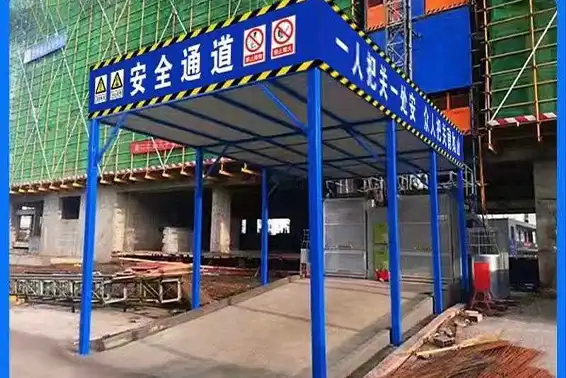
Outdoor Carpentry Risks a Canopy Helps Control
Rain, Sun, and Temperature Swings
When it rains, wood swells up, and power tools can get broken. According to NIOSH, the best ways to deal with heat are to rest and stay out of the sun. Being in direct sunlight makes heat stress worse. You can work outside in the rain under a carpenter working canopy. It also keeps your tools safe and gives you a place to rest in the shade between cuts. Since the roof is 3700 mm (12.1 ft) high, there is room under it for tall panels. It saves time and work in the long run to cover wood that has been dried in a kiln so that it doesn't warp and swell. It is not 100% waterproof, but a carpenter working canopy keeps workers safe while they cut, measure, and put things together, without having to deal with rain or bright lights.
Dust, Noise, and Flying Chips
You saw and plane made a lot of dust, noise, and chips that flew around. The International Agency for Research on Cancer has said that people can get cancer from wood dust. NIOSH also says that noise levels should stay below 85 decibels during an eight-hour shift. You should still wear a mask, earplugs, and saw guards even though there is a cover. Also, OSHA's rule in 29 CFR 1926.304 about woodworking tools is still in effect. With a cover, the work stays in one place. Other people on the job site won't be able to hear noise, see dust, or smell wood chips from our carpenter working canopy. Not as many people will be near the spray zone, which means there will be less danger.
Fire Risk Around Sawdust and Hot Work
Dust from saws, trash, and hot work nearby can be very dangerous if they come together. There is NFPA 241 that talks about fire safety in buildings and NFPA 652 that talks about flammable dust and how it works. It is most important to be clean, but what you wear is also important. The top and sides of our cover are made of fire-resistant materials, and it sits on a steel frame. In this case, the building is made to meet the fire safety rules for places where people work with wood. Those who are in charge of safety and are getting ready for checks often ask this first. What are the fire code rules in your area? I think you should ask your inspector about that before you decide or place an order.
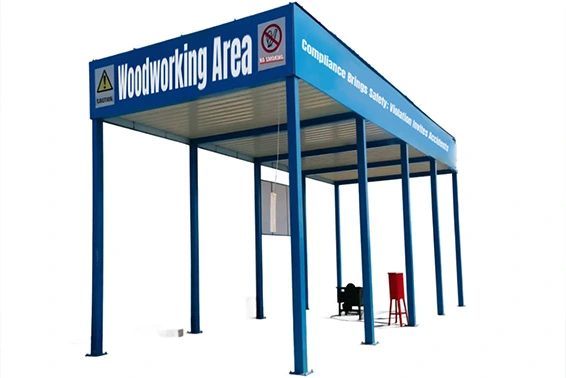
Key Safety Features of a Carpenter Working Canopy
Steel Frame and Load-Bearing Strength
The frame of a canopy keeps it stable. As required by law, it is made of high-strength steel and has two sides and two columns. The base of each column is 100 mm x 100 mm, or 3.9 in., and the walls are 2 mm thick. The walls are 2 mm thick and the main beams are 50 mm x 50 mm. The side beams are 50 mm x 50 mm at 1.5 mm, and the purlins are 30 mm x 50 mm. The size of this heavy-duty carpenter working canopy is 6000 mm x 3000 mm (19.7 ft x 9.8 ft). It can hold weight and protect against impacts. When you compare things, look at the wall thickness and the size of the tubes. Steel that is lighter is easier to bend and rust through.
Fire-Retardant Top and Surrounding Protection
To protect the top and the area around it, things that don't catch fire are used. These things can also take being hit. That's important in a woodworking shop where scraps and blade chips can fly around. It stops spills, keeps things quiet, and keeps dust out, which is what a lot of people look for in sidewalls. It also gives inspectors a clear area to see the tools from. The company that made the safety gear might be able to give you written information about it. If you make things clear, everyone can do a fire safety check better.
Rust-Resistant Coating for Outdoor Use
It is possible for steel to get wet, humid, and cold when it is used outside. Employees of our company paint all of our steel surfaces, which makes them less likely to rust. You don't have to treat the surface because Xinjiuyi's goods are made to last up to twenty years. If you coat something, you can also change how it looks. It is important to know this for model sites and inspection tours. For the finish, you can use colors from different brands. Ask each company how they deal with steel when you compare prices. To use a cheap canopy that rusts after one season costs more and puts you at greater risk.
Planning a Safer Carpenter Canopy Workspace
Carpenter Canopy Size Guide
To plan a carpenter working canopy workspace, you should write down the workbench, the table saw, the miter saw, and the longest board or formwork panel that your crew may use. After that, give people room to walk around each area. It's 6000 mm long, which is about 19.7 ft, and 3700 mm tall, which is about 12.1 ft. It has three widths: 3000 mm, 4000 mm, and 6000 mm. It's the same as 9.8 feet, 13.1 feet, and 19.7 feet. A 3000 mm width might be big enough for one cutting line, but a wider width lets you add a second stand or set up stuff. We can change the width, height, and length if these don't work for your site.
Separating Cutting, Assembly, and Storage
With a good plan, things go in one direction. Put the raw wood on one end. Put the cuts in the middle. Put the last few pieces on the other end. Make sure no one is in the way of the saw's path when it kicks back. Wide coverage area helps this flow, and two types of protection make it safe for workers on both sides to do their jobs. When building forms are put in place, tall panels can stand straight up under the 3700 mm roof line. People are less likely to trip, mix up, or crowd around moving blades when there is a clear line between raw materials, parts that are still being worked on, and parts that are done.
Lighting, Power, and Exits
A strong frame won't help if the work area is a mess. Do not let the cords touch wet ground or walk on them. Outdoor cords should be used. U.S. job sites that need temporary power must have either a ground-fault circuit interrupter or a guaranteed equipment grounding wire program in order to follow OSHA rules. A task light above the cutting stations will help workers see the plan lines and blade tracks better. Clear the way in and out of all the stacked wood and scraps. Quickly walk through the space before your first shift as if an alarm had just gone off. Take care of anything that is in the way of your exit.
Carpenter Working Canopy vs. Other Outdoor Shelters
Gazebos and Pop-Up Canopies
Party and small home projects are great for gazebos and canopies that pop up. It's hard to move sawdust and heavy lumber with these frames because the legs are thin and light. You also have to use them over and over on the job site. A carpenter working canopy is designed to fit tools, has parts that are bolted together, and is made of stronger steel. One person can't take a steel unit to a truck by themselves, so weight is a trade-off. For a team that is moving around and making a deck over the weekend, a pop-up might be enough. During a long project, a custom-made job site cover that you can move around can save you a lot of time and money.
Permanent Workshops
The safest choice is the one that stays put, but it needs room, time, and permission to be made, and it stays there after the job is over. When we put our cover together, we use standard welding and a way to connect modules with bolts. You don't need special tools or a lot of people to move it around and put it back together again. This means crews don't need to use them to do it. It can be used on more than one site, which is helpful for general contractors who are always starting new jobs. When there is only one pattern, it's also easier for distributors to keep in stock and explain to customers.
Open Roof or Enclosed Sides
Open plans make it easier to get to things and let air flow. When the sides are closed, more of the wind-driven rain, dust, and noise are kept out. Because chips and dust move around them, woodworking tools normally work better when they are closed off. That's why our cover has safety edges all the way around it. Still, there shouldn't be any walls that make it hard for air to flow or for light to come in. Think about the tools you have, the wind direction, how long the job will take, and what the inspector wants before you make your choice. Send us your site plan, and we'll help you figure out what to do.
Setup, Maintenance, and Buying Guidance
Safe Installation and Relocation
Before you put it together, check the ground for slopes, drains, utilities, and power lines that run above and below. Talk to the seller and someone who knows about the site to make sure you know what kind of base or anchor you need. Just put it together the way it says to, and make sure all the bolts are tight before putting tools in the area. Our precise parts fit together so well that putting them together takes less time and work. We'll also help you set it up, and you'll get written instructions and a list of the parts. If you move the carpenter working canopy, you should check each joint again because the weight of the moving can loosen them or scratch the coating.
Inspection and Maintenance Routine
Keeping a canopy safe is simple and quick. At the start of each shift and again after storms, check the columns, beams, purlins, and bolts. Look out for rust, loose bolts, bent parts, and coating that has been chipped off. Small pieces of wood and other things can catch fire and cause people to trip if they pile up, so sweep it up every day. As soon as you see a scratch on the steel, fix it. Keep an easy log of dates. Safety teams have to keep records on most projects in case they need to be checked. It also knows when parts need to be replaced.
Questions to Ask a Carpenter Working Canopy Supplier
Find out what the fire-resistant material is made of, when it will be brought, how big and wide the steel walls will be, and if you will need help putting it up. Distributors should also find out what sizes of stock are usually on hand and how fast the plant can fill special orders. People who want to buy a brand should talk about names, colors, and language that shows danger. Xinjiuyi has ISO 9001, ISO 45001, and ISO 14001 standards, and its major office is in Cangzhou, Hebei. We keep standard specs in stock so that we can ship quickly, and we offer full customization, including 3D models before the sale. That person can talk to project teams, dealers, and OEM buyers all at the same time whilst making and delivering the goods.
Conclusion
A carpenter working canopy keeps the risk of fire down near sawdust, shields boards and tools from rain and sun, and blocks out dust, noise, and wood chips when working outside. There should be safety around the sides and a strong steel frame on the best ones. The finish should also not rust. The 100 mm × 100 mm column form we talked about above has all of these things. To keep everyone safe, make sure the cover fits the tools well, set up cut, put together, and store tasks in a way that makes sense, and keep an eye on the power cords and exits. Another option is a permanent workshop or a gazebo. A bolted steel canopy is better because it is strong and simple to move. With clear instructions from the seller, that safety measure will last a long time as long as it is set up correctly and checked often.
FAQ
What size should I choose?
Make sure the carpenter working canopy fits your tools, the length of your pieces, and the space you need to walk. You can get it in 3000, 4000, or 6000 mm sizes. It is 6000 mm long and 3700 mm high. You can ask for various sizes.
Is a steel canopy better than a pop-up shelter?
Most of the time, it will be used over and over on the job site. These are made of steel, which is stronger and less likely to break. On the other hand, pop-up frames work best for quick, easy jobs.
Can the canopy show my brand?
Yes. The signs, colors, and logos can be changed. We can also add safety text in more than one language if needed.
Does it meet U.S. code?
When we make our cover, we follow the rules for safe building and fire safety. There are different rules in each place, so please let us know what they are before you place your order.
Can crews move it between projects?
Yes. Because they are held together with bolts, you don't need any special tools to move things around or take them apart.
Request a Quote for Your Carpenter Working Canopy
With ISO 9001, ISO 45001, and ISO 14001 standards, Xinjiuyi is a carpenter working canopy maker in Cangzhou, Hebei. Our warning signs come in many shapes, colors, names, and languages, and can be made to order. Our team can also draw plans for things before they are built. Tell global@xjy8.com how big, how many, and how you want to ship your items.
References
1. International Agency for Research on Cancer, IARC Monographs on the Evaluation of Carcinogenic Risks to Humans, Volume 100C: Arsenic, Metals, Fibres, and Dusts, 2012.
2. National Institute for Occupational Safety and Health, Criteria for a Recommended Standard: Occupational Noise Exposure, Revised Criteria, 1998.
3. National Institute for Occupational Safety and Health, Criteria for a Recommended Standard: Occupational Exposure to Heat and Hot Environments, 2016.
4. National Fire Protection Association, NFPA 241: Standard for Safeguarding Construction, Alteration, and Demolition Operations, 2022.
5. National Fire Protection Association, NFPA 652: Standard on the Fundamentals of Combustible Dust, 2019.
6. U.S. Code of Federal Regulations, Title 29, Part 1926: Safety and Health Regulations for Construction, 2023.