Top 10 Applications of Stainless Steel Bar Grating
Stainless steel bar grating serves as a structurally reliable, corrosion-resistant drainage and load-bearing solution across municipal, industrial, and commercial environments. Its open-surface design efficiently separates liquids—rainwater, sewage, and wastewater—from solid debris such as leaves, stones, and waste, preventing blockages in pipe networks and drainage channels. Available in 304, 316, and 201 alloy grades with slot spacings from 20 mm to 100 mm and plate thicknesses from 2 mm to 8 mm, this product delivers a verified service life of 15 to 30 years, making it a dependable long-term investment for procurement teams managing high-demand infrastructure projects.

What Is Stainless Steel Bar Grating and Why Does It Matter?
Stainless steel bar grating is made up of load-bearing flat bars that are welded or pressure-locked to perpendicular cross bars to make a solid panel with an open surface. The panel's structural capacity and fit for certain load classes depend on how it was made—whether it was soldered, press-locked, or swaged.
Core Material and Performance Properties
The levels of chemical protection for alloy types 304, 316, and 316L are all different. Because it has 2–3% molybdenum, grade 316 is much more resistant to pitting in chloride-rich or acidic conditions than grade 304. ASTM A666 and NAAMM MBG 531 say that certified panels have to meet very strict requirements for their sizes, the quality of their welds, and how much they bend under load. These standards are required—they directly affect whether a grating panel passes an on-site inspection or needs to be replaced, which can be expensive.
Here are the main structural benefits of this material that make it the best choice in all fields:
- Corrosion resistance: Grades 304 and 316 can handle rust, acid, and chemical exposure in drainage ditches outside and hygiene-critical areas inside, keeping the integrity of the surface without coating wearing away.
- Extended service life: If you choose the right panels, they will work reliably for 15 to 30 years, which is a lot longer than galvanized carbon steel options and saves you a lot of money on upkeep.
- Load-bearing flexibility: Panels can meet load classes from walking walks to light vehicle zones because the plate thickness can be changed from 2 mm to 8 mm and the bar spacing can be changed.
These benefits directly address the two most common problems in procurement: structures that fail too soon and maintenance costs that keep going up in harsh environments.
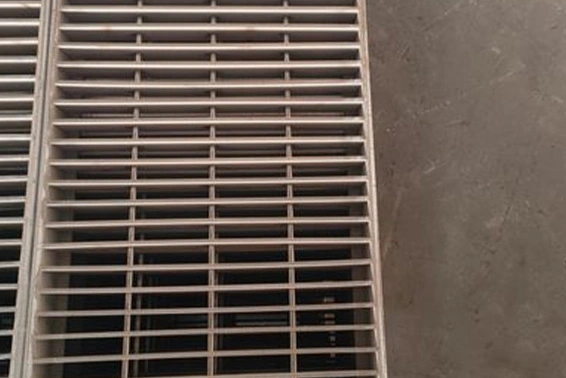
Top 10 Applications of Stainless Steel Bar Grating
In these ten situations, welded or press-locked drainage grating gives the best performance value that can be measured. In each case, there are different technical needs that normal aluminum or carbon steel panels can't always meet.
1. Municipal Road and Urban Drainage Systems
Drainage systems in cities need grates that can catch garbage without slowing down flow rates. Optimized slot spacing keeps pipes from getting clogged and makes it easy for maintenance workers to get to the road during repair cycles.
2. Landscape Plazas and High-End Public Spaces
Drainage systems that look good and work well are needed in commercial plazas and high-end apartment complexes. Modern building finishes look great with the natural shiny sheen of stainless steel bar grating panels.
3. Food Processing Facilities
Meat processing plants, breweries, and dairy farms need drainage trenches that aren't porous and are easy to clean. Polished 304 or 316 panels meet FDA cleanliness rules because they smooth out the surface, making it less likely for germs to grow.
4. Commercial Kitchens and Restaurant Infrastructure
Every day, hot water, cleaning products, and grease are put on kitchen floor grates. Panels made of 304 stainless steel don't break down when exposed to chemicals and can be washed directly with high pressure without damage to the surface.
5. Pharmaceutical and Cleanroom Environments
In areas where drugs are made, it is necessary to have uniform slot shape and electropolished surfaces. Here, grating panels have to pass quality assurance checks that check both the accuracy of the measurements and the risk of surface contamination.
6. Chemical and Petrochemical Processing Plants
Structures in refineries and places that handle acids are exposed to acids that quickly break down galvanized steel. Grade 316 panels keep their structural integrity even after being exposed to chemicals for a long time.
7. Marine and Coastal Infrastructure
For offshore platforms, desalination plants, and seaside paths, constant resistance to salt spray and immersion in salt water is needed. 316-grade panels have molybdenum in them, which stops pitting corrosion that weakens structures over time.
8. Wastewater Treatment Facilities
The paths and channel covers in a treatment plant are always exposed to sewage gasses and harmful biological agents. In this case, stainless steel panels last longer and pass inspections more easily than carbon steel panels.
9. Construction Site Trench Covers and Temporary Platforms
Temporary site drainage depends on strong panels that can handle the weight of building tools and the flow of muddy water. During the building process, high structural strength makes sure that people and tools can safely move across open trenches.
10. Power Generation Facilities
In power plants, grating that can handle both heat and chemical cleaners is needed in cooling towers, turbine platforms, and maintenance walkways. These operating pressures work together to keep the dimensions of stainless steel panels stable.
Comparing Stainless Steel Bar Grating with Alternative Materials
A lot of the time, procurement teams compare galvanized carbon steel, aluminum, fiberglass reinforced plastic (FRP), and stainless steel. Each option comes with trade-offs that are more or less important based on the situation.
Carbon steel grating is cheaper up front, but the covering needs to be maintained regularly and replaced in places where it will rust. A lifecycle cost study usually shows that the extra money spent on stainless steel is recouped in five to eight years through lower upkeep costs. Aluminum panels are lighter, but they can't hold as much weight or last as long if they are used in heavy-duty industrial or municipal settings. While FRP panels are resistant to chemicals, they are not as strong or fire-resistant as stainless steel when used in high-temperature settings.
It makes sense for buying teams in charge of long-term building projects to come to this conclusion: stainless steel bar grating has a lower total cost of ownership in situations where corrosion, hygiene, or structural load standards can't be ignored.
Procurement Insights: What to Verify Before Placing an Order?
Decisions about where to get things have real effects on project timelines and compliance results. Several steps of verification keep procurement teams safe from quality problems that show up after the installation is done.
The most important step is being able to track down materials. For each batch, suppliers should give mill test papers that show what the metal is made of. Positive Material Identification (PMI) testing can be done on-site to make sure that the panels delivered are the right grade of 304 or 316 steel. This is done to avoid using lower-grade replacements that rust too quickly.
Before bulk transport, the dimensions must be checked against the project plans to make sure they are correct. Differences in slot spacing and panel flatness tolerances have a direct effect on how well the fitting fits and how well the draining works. When procurement teams work with Xinjiuyi, they get tracked material certificates for 201, 304, or 316 alloys along with measurement verification reports for every production batch before it is shipped.
For export purchases, suppliers should give origin certificates, load test data, and export packaging specifications. For sea freight, moisture- and rust-resistant packaging is a must, not a nice-to-have extra.
Best Practices for Installation and Long-Term Performance
Avoidable structural stress can be avoided with proper fitting. When the panels are put in place, they are aligned so that the load is spread evenly across the support frame. Instead of being hand-tightened, securing clips or pin nuts should be torqued to the right level.
Stainless steel bar grating panels don't need much regular upkeep, but they do need some. Keeping an eye on the slot openings for debris buildup on a regular basis keeps the flow going. In places where cleanliness is important, like food processing plants, regular pressure washing with approved cleaning products keeps the surface clean between audits. For pharmaceutical or marine uses, electropolishing is recommended because it strengthens and replaces the chromium oxide inactive layer after it has been made.
Conclusion
Stainless steel bar grating is used in a huge variety of places, from cleanrooms for pharmaceuticals and offshore platforms to draining water from city streets. Three things—choosing the right material grade, making sure the measurements are correct, and checking the reliability of the supplier—determine whether a purchase will last and save money in the long run or cause costly replacements. If you get stainless steel grating panels from a reliable source and follow the right specifications, they will last longer than other options for 15 to 30 years. When procurement teams buy verified-grade panels that are correctly defined, they cut down on upkeep costs and project risk in a measurable way.
FAQ
What grade should I specify for a coastal or marine environment?
Grade 316 is the right choice for places that are constantly exposed to saltwater or chloride. Its molybdenum percentage of 2–3% makes it much more resistant to cracking than 304. 304 is the standard for freshwater drainage or indoor uses that won't be exposed to chemicals.
How do I verify that delivered panels match the specified alloy grade?
For each batch, ask for a mill test certificate. For high-stakes uses, test received panels with PMI to prove the alloy makeup. Reliable suppliers of stainless steel bar grating always include paperwork that can be used to track the product.
Can panels be fabricated to non-standard dimensions?
Yes. Manufacturers who can do CNC fabrication can make slots spaced at any distance, panels of any size, and plates of any thickness. Xinjiuyi makes panels based on plans from customers. The plate thickness can be between 2 mm and 8 mm and the hole spacing can be between 20 mm and 100 mm.
What surface finish is appropriate for food processing environments?
Polished or electropolished surfaces are smoother, which makes them easier to clean and less likely for bacteria to stick to them. Panels with a mill finish can be used for outdoor drainage and construction projects where cleanliness is not a concern.
What is the realistic service life for outdoor municipal drainage applications?
Service life can be anywhere from 15 to 30 years if the right grade is chosen (304 or 316, based on the location). In order for this standard to be valid, it must be installed correctly and cleaned regularly.
Partner with Xinjiuyi for Reliable Stainless Steel Bar Grating Supply
Xinjiuyi makes approved stainless steel bar grating that meets the needs of cities, businesses, and exporters. Our panels come with quality documentation that is ISO9001-certified, certificates that show where the materials came from, and the ability to be made to order based on your project drawings. Contact our team at global@xjy8.com or visit xjy8.com to get a quote that fits your needs, whether you need large amounts for infrastructure projects or panels with special dimensions for cleanrooms.
References
1. National Association of Architectural Metal Manufacturers (NAAMM). Metal Bar Grating Manual (MBG 531/532). 2020.
2. ASTM International. ASTM A666: Standard Specification for Annealed or Cold-Worked Austenitic Stainless Steel Sheet, Strip, Plate, and Flat Bar. 2022.
3. ASTM International. ASTM A1011: Standard Specification for Steel, Sheet and Strip, Hot-Rolled. 2021.
4. European Committee for Standardization. EN 10088-2: Stainless Steels — Technical Delivery Conditions for Sheet/Plate and Strip. 2014.
5. Outokumpu Stainless. Corrosion Handbook: Stainless Steel Grades and Their Applications in Industrial Environments. 2019.
6. American Institute of Steel Construction (AISC). Steel Construction Manual, 16th Edition. 2023.