Adjustable Steel Prop for Building Construction: Buyer’s Guide
If you're looking for vertical support systems for concrete formwork, it's important to know what an adjustable steel prop can do for your job. These flexible shoring devices are the backbone of safe, efficient slab and beam building. They allow for height adjustments and provide the load-bearing capacity needed while the concrete cures. Instead of fixed-height options that need a lot of customising or improvising on the job site, modern steel props offer millimeter-level accuracy through threaded adjustment systems that can work with different substrates while still keeping structural integrity. Choosing the right prop design has a direct effect on how well workers do their jobs, how safe the project is, and how much it costs overall. This is especially true for procurement managers, health and safety officers, and project engineers who are in charge of building high-rise buildings, bridges, or expanding industrial plants.
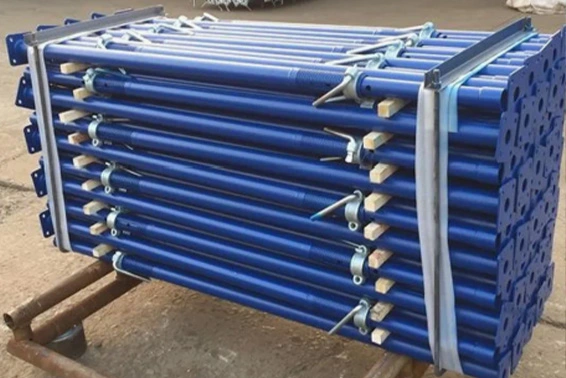
Understanding Adjustable Steel Props: Features, Uses, and Benefits
Learn about the features, uses, and benefits of adjustable steel props.
Core Components and Design Architecture
Both sections of a good steel shoring prop function together. Our Q235 carbon steel inner and outer tubes fit together for the highest strength-to-weight ratios. A threaded collar allows you adjust its length, and welded base plates distribute stresses uniformly across formwork beams. In contrast to permanent scaffolding, its telescoping form may be employed for ceiling heights from typical house ceilings to industrial spans exceeding five meters.
Adjustability is the biggest difference between hobbyist and professional gear. Proven props feature coarse-pitch threads in hardened steel sleeves. These prevent threads from wearing out after hundreds of assemblies. People forget that the locking pin requires high-tensile steel to withstand big loads while buying. This element helps you determine whether your prop fleet maintains safety certification across projects.
Primary Applications Across Construction Sectors
Residents employ light-duty props for basic floor slab formwork to lighten wall sections due to regular loads and low heights. Apartments and townhouses work best around 1.7–3 meters. Setting up swiftly pleases your teams, which reduces labor expenses when adding floors one after another.
Industrial sites need heavy-duty specs. Warehouses with long beams, factories with large concrete volumes, and factory floor slabs where equipment loads are carried demand stronger steel walls and tubes. More material prevents these units from buckling under rotating stresses. Bridge decks are harder to build because the soffit formwork must support lots of concrete while allowing the workers to reach below. Adjustable steel props may collapse to fit through narrow spaces and extend to full height thereafter.
Tools suffer during tunnel lining. Concrete alkalinity, excessive moisture, and temperature variations accelerate rust in untreated steel. Props used in these settings should be hot-dip galvanized. 60–80 micron zinc coatings protect props and extend their lifespan. Propping brick walls during beam replacement or openings is utilized as temporary needling support in structural repair operations. Since you're sustaining building loads, not simply new concrete, this application requires a precise load estimate.
Advantages Driving Market Adoption
Reusability revolutionizes tool economy. Traditional wooden coastlines fall down after one usage in wet concrete, making them costly and hard to dispose of. Properly maintained steel props may be used hundreds of times, extending their cost over many years. These durability benefits contractors that manage several locations or regional distributors who service rental markets.
Worker efficiency increases with each launch. No welding or difficult construction stages are needed with modular linkages. Pre-made wood or scaffolding tubes take longer to put up, extend, and secure than two people. Standardised props simplify training and reduce placement expertise in safety. After installation, changing the height enables you modify foundation settling or formwork alignment without removing the supports. You may increase or decrease support points by millimeters by turning the adjustment collar. This level forms formwork while the concrete cures. Working on uneven surfaces or handling heat buildup during large-pour conditions is easier with this functionality.
Adjustable Steel Props vs Alternatives: Making the Right Choice
Comparative Analysis of Support Systems
Timber props used to be common on construction sites because they were easy to find and didn't cost much. But wood isn't good for professional use because its measurements aren't always uniform, its dimensions change when it gets wet, and it can only be used once. Steel shoring posts are uniform, but they can't be adjusted in height, so builders have to keep a lot of different lengths on hand. Modular connections in scaffolding tube systems give you more options, but they take a lot more work to set up and require more advanced skills to make sure they are safe.
Early industry standards were set by Acrow Props, a brand name that became associated with adjustable steel props. Modern alternatives made by certified manufacturers meet or go beyond these original requirements and often have better designs as well. When deciding between choices, you should look at performance factors that can be measured instead of brand history. Load capacity rates, tube diameter standards, and wall thickness measurements are better ways to figure out what a job site can actually do than just the name of the maker.
Material Selection and Surface Treatment Considerations
The difference between hot-dip galvanised and pre-galvanized props has an impact on both the cost at first and the value over time. Hot-dip galvanization adds a zinc covering after the metal is fabricated, making sure that all areas are covered, even the welds and cut edges. This method makes the strongest and thickest corrosion shield, which is important for seaside areas, tunnel work, and any other job that will be exposed to water for a long time. Before it is formed into tubes, zinc is coated on pre-galvanized sheet steel. This provides enough security for indoor or short-term outdoor use at a lower cost. Knowing how exposed your project is to the world lets you make the right specifications without spending too much on security that you don't need.
Painted finishes are useful for projects that need to use colour coding for load rating identification or to keep the site organised. Industrial-grade paints can handle being handled rough and are somewhat resistant to rust, but they need to be maintained more often than galvanised options. In comparison to liquid paints, powder coating with thermal sealing looks better and lasts longer, making it the best choice for finishing when both looks and function are important.
Certification and Manufacturing Standards
ISO 9001 certification means that a company has documented quality management systems, but it doesn't mean that the products will work well. Test certifications that show the actual load capacity under controlled conditions are more useful for choosing props. Reliable makers offer load charts that show the safe working loads at different extension heights. This is important information for engineers who need to figure out prop spacing and formwork design. The position of the factory affects wait times and the difficulty of logistics, but that shouldn't automatically affect how people feel about the quality. Modern factories in well-known manufacturing areas often use cutting-edge tools and strict process controls to make props that meet international standards. Instead of making assumptions based on location, your evaluation should be based on measurable specs, testing documentation, and how open the provider is.
How to Select the Best Adjustable Steel Prop for Your Project
Calculating Load Requirements and Size Specifications
Selecting adjustable steel props begins with load calculation. Each prop must support the weight of the concrete slab, the formwork system, the live loads being created, and Impact factors. Based on drainage area estimations, structural engineers provide kilonewtons of support. You then pick props rated higher than this requirement, keeping in mind that extension height affects capacity. Slenderness ratio—the tube's stretched length to width—determines buckling risk. Squeezing props holds more weight than stretching them to full height.
The normal residential floor formwork with a 200 mm slab thickness may need props placed 1.2 meters apart and sustaining 15 kN apiece. Industrial slabs above 300 mm with hefty formwork beams may demand 25 kN. When making a purchase, ensure sure the product specs meet these estimated demands, taking local building code safety aspects into account. Wall thickness impacts load capacity. Industrial props have 3.0 or 4.0 mm walls, whereas light-duty props have 1.6 mm walls. Tube capacity and stability depend on diameter. Larger tubes are less likely to buckle; thus, they may be expanded without compromising safety.
Quality Indicators and Inspection Criteria
Material clearance documentation ensures steel grades are met. Strength and flexibility make Q235 carbon steel ideal for construction shoring. Although lower-grade steel is cheaper to produce, it is weaker and less durable. When buying, ask for mill test certifications to ensure materials fulfill technical standards. Weld strength impacts base plate-tube connection. Checked full-penetration welds for holes and slag inclusions to prevent stress concentration failure. Smooth, uniform, and defect-free weld beads should be visible. Ultrasonic waves from advanced sources verify welds in ways that can't be observed.
Precision in thread machining impacts lock and adjustment performance. Ensure the threaded cap pitch and depth are consistent. The manufacturing tolerances were not fulfilled, therefore mating threads have too much flexibility, which may worsen with time and cause undesired height variations when loaded. Safety demands strong closing action, and good props maintain their threads engaged securely throughout their lifespan.
Procurement Strategy and Total Cost Analysis
Bulk purchases might save money, but you must consider storage expenses and space. Owners of a fleet may spread the expense of equipment across numerous assignments, which benefits busy contractors. Since they just pay for equipment usage, rental agreements may be cheaper for smaller enterprises or those that simply require formwork. Lead times affect project timing. Domestic providers may usually deliver quicker but offer fewer customization possibilities. International suppliers provide distinctive designs and affordable rates, but shipment takes longer. To prevent schedule modifications, your purchasing timeline should include how long it takes to create, inspect, and ship the items.
Transportation logistics affect delivery costs greatly. Packing props for shipment in containers is straightforward, but weight and dimensions affect freight costs. Find out whether a supplier's quotation covers delivery to your address or only the factory gates. That difference greatly affects the price of things. Buying from abroad is simpler since established suppliers work with freight forwarders that specialize in shipping construction equipment.
Installation, Maintenance, and Safety: Maximizing Performance and Longevity
Proper Setup Procedures for Safe Operation
Placing the base plate provides stability. Install plates on flat, firm surfaces that can withstand point stresses. Timber or steel base plates distribute the load across the formwork beams to avoid crushing. The prop should be straight to avoid lateral instability and decreased load capacity. Most manufacturers mention the maximum two-degree deviation from plumb.
Thread depth impacts lock safety. Set the adjustable steel props at the proper height and ensure threaded contact between the inner and outer tubes. Thread stripping under stress might collapse the structure without adequate engagement. Put the locking pin through the holes in both lined-up tubes to make sure it sits. The structure won't come apart if the thread engagement fails with this added safety feature. Follow up with all connections after the initial placement and before the concrete pour. Connectors should be examined often throughout critical construction phases since concrete-laying equipment might loosen them.
Maintenance Practices Extending Service Life
Thread lubrication prevents sticking and simplifies damage repair. Apply dry lube or penetrating oil to threads before and after all jobs. Extra dirt-attracting material should be removed. Avoiding binding that generates too much power during adjustment, this basic procedure runs smoothly for hundreds of cycles. Storing impacts corrosion and cohesiveness. Keep props in safe, well-ventilated areas when unavailable. Store objects horizontally so they don't bend permanently, which might ruin your straight line. Checking parts before they go to work should reveal damage. Watch for tube dents, twisted base plates, crooked threads, and missing sealing pins. Discontinue damaged units immediately—the expense of replacing props is minor compared to formwork collapse.
After exposure to concrete, cleaning removes hardened concrete buildups that hinder flexibility and eliminates pH attack. Hard-to-reach areas may be cleaned using a wire brush and pressure washing. Before rust begins, paint over any steel displaying coating deterioration ASAP. Maintaining your equipment will safeguard your investment and ensure safe launches.
Load Monitoring and Dynamic Safety Considerations
Builders apply dynamic forces to static load calculations in prop specifications. Moving people, placing supplies, and pouring concrete cause impact loads greater than stable plan values. Engineered safety considerations account for these issues, but they only operate if the equipment is properly installed and maintained. Props nearing their maximum extension height operate at full capacity. Closer to maximum length, the safety gap shrinks. It's crucial to calculate loads accurately and space carefully. Ask for the next higher duty grade when project demands push props near to their rated limits to ensure safety.
Procurement Guide: Buying Adjustable Steel Props with Confidence
Identifying Reliable Suppliers and Manufacturers
Manufacturing competency is the first step in assessing a supplier. Long-standing companies have tube-forming machinery, welding stations, galvanizing lines, and quality control laboratories. This vertical unity ensures product quality and allows customization for non-standard applications. Contact a third party for facility documentation or audit reports to verify production statistics and manufacturing capability. Certification portfolios demonstrate safety and quality commitment. ISO 45001 certifies occupational health and safety, whereas ISO 9001 demonstrates quality. Lab tests with product-specific certifications support load capacity claims. These records verify the manufacturer's product claims.
Customer references provide non-marketing information. Ask existing customers about shipping, product stability, and post-sale support. Multi-purchasers feel you performed well, which is better than a sales presentation. Service location affects response times and delivery costs. Suppliers with established freight agreements or regional distribution networks usually deliver more reliably than those that need international shipment. Find out whether a supplier's service area matches your company and initiatives.
Price Evaluation and Value Optimization
Know what each pricing includes to compare prices. When selling "ex-works," some dealers don't include freight, insurance, or import taxes. Others provide delivery pricing that cover your chosen location. Consider the same items while comparing pricing. Extra fees may make the cheapest price the most costly. The minimum order quantity varies by supplier and pricing level. Discover how costs vary by quantity and determine whether your shopping habits enable bulk purchases. Combining orders from several projects lets you achieve bulk discounts without overstocking any site.
Some value-added services merit higher prices. Engineering evaluation of formwork drawings, technical assistance with specification selection, and on-site installation training all save costs. Consider more than pricing while comparing suppliers. Cheapest unit cost may not be greatest value. Terms of payment affect cash flow and risk distribution. For overseas commerce initial orders, letters of credit or advance payment are usual. Stronger relationships lead to open account conditions. Discover what suppliers want and how it fits within your finances. Effective working capital management may offset increasing unit pricing with excellent payment terms.
OEM versus Aftermarket Considerations
OEM items are well-known and often function effectively. Because of their reputation and field testing data, these tried-and-true designs attract premium pricing. Aftermarket choices may do the same job for less money, but certain purchasing policies need testing records and name warranties. Consider brand preferences, price, and needs while choosing. Normalizing your adjustable steel prop fleet simplifies maintenance and parts. Your props will have the same thread patterns, base plate diameters, and locking pin sizes if you purchase them from one source. Uniformity simplifies training, reduces spare part inventory, and simplifies tool assignment (work locations).
Conclusion
During the concrete construction phases, choosing the right vertical support system affects the safety of the forms, the efficiency of the workers, and the cost of the project. Quality adjustable steel props made from approved materials, finished with the right corrosion protection, and the right size for your load needs will work reliably for hundreds of project rounds. A good buying process strikes a balance between exact specifications and evaluating suppliers. This makes sure that the equipment you get meets both technical needs and budget limits. Taking the time to carefully evaluate products and suppliers pays off in the form of fewer accidents, lower lifecycle costs, and higher building efficiency. When your projects need reliable formwork support systems backed by quick technical support, working with well-known manufacturers gives you the peace of mind you need to meet your safety and timeline obligations.
FAQ
1. What load capacity should adjustable steel props handle?
For how much weight should adjustable steel props be able to hold? How much weight something can hold depends on the tube's width, wall thickness, and extension height. Formwork for homes usually needs 15-20 kN of strength per prop, but 25-30 kN or more may be needed for industry uses. Always look at the manufacturer's load charts to see how much weight an extension can hold at different heights, and make sure the one you choose has the right safety factors for your area's building codes.
2. How do adjustable steel props differ from Acrow props?
Acrow props are a certain brand that set early standards for adjustable steel props that can be adjusted. Modern replacements made by qualified companies usually meet or beat the original Acrow requirements. The basic idea behind how it works hasn't changed: flexible steel tubes with threaded adjustment systems. When comparing options, you should base your judgement on features that can be measured instead of brand names.
3. Can we rent adjustable steel props instead of purchasing?
Rental services are good for builders who only need formwork for one job or a few projects at a time. With this method, you don't have to worry about cash investments or upkeep. However, regular users usually get better economics by owning a fleet of equipment, which spreads the cost of the equipment over many projects while keeping it available at all times. Look at how much you use each year to figure out which method will save you the most money overall.
Partner with Xinjiuyi for Reliable Construction Support Solutions
Hebei Xinjiuyi Construction Technology Co., Ltd. makes professional-grade adjustable steel props that are designed to meet the unique needs of today's construction projects. Our adjustable steel prop systems are made from proven Q235 carbon steel and have tube sizes ranging from 40mm to 60mm and wall thicknesses of up to 4mm. They can hold loads for both home and heavy commercial uses. We offer a full range of surface treatments, such as hot-dip galvanisation for maximum corrosion resistance. This will make sure that your investment in equipment lasts for decades and is reliable in a wide range of project settings.
Our ISO 9001, ISO 45001, and ISO 14001 standards show that we care about quality control, worker safety, and being good to the environment. In addition to standard sizes, we also offer full customization, which means that we can make props that are exactly the right height, weight, and setting for you. Our technical team will look over your formwork plans for free and suggest the best ways to set up your props so that safety needs are met and costs are kept low. Contact our procurement specialists at global@xjy8.com to talk about your project needs with an experienced adjustable steel prop supplier who wants to help your construction project succeed by giving you quality products and quick service.
References
1. Brown, Michael T. "Temporary Works Design: A Guide to BS 5975. "The Structural Engineer, Volume 91, Issue 8, Construction Industry Press, 2013, pp. 28-35.
2. Chen, Wei-Fah and Duan, Lian. "Bridge Engineering Handbook: Construction and Maintenance." CRC Press, Taylor & Francis Group, Second Edition, 2014, pp. 412-438.
3. Hadipriono, Fabian C. and Wang, Hui-Kai. "Causes of False-Work Collapses During Construction." Structural Safety Journal, Volume 4, Issue 3, Elsevier Science Publishers, 1987, pp. 179-195.
4. Institution of Structural Engineers. "Temporary Demountable Structures: Guidance on Procurement, Design and Use. "Third Edition, IStructE Technical Guidance Note, London, 2007.
5. Peng, Jeffrey L. and Ho, Chi-Ming. "Structural Performance of Adjustable Steel Props in High-Rise Building Construction." Journal of Construction Engineering and Management, Volume 138, Issue 6, American Society of Civil Engineers, 2012, pp. 781-789.
6. Whitaker, Stephen M. "Formwork: A Guide to Good Practice." Third Edition, Construction Industry Research and Information Association, Concrete Society Technical Report, 2012, pp. 145-167.